Multidisciplinary Flexibility: Using AI to Support the Viksit Bharat Shiksha Adhishthan Bill (VBSAB) Transition
Excerpt: The bill that would replace UGC with a single streamlined regulator also demands higher education's hardest structural change: multidisciplinarity — institutions that span disciplines, learners who cross them. Regulation can be rewritten overnight; the operating model of every institution cannot. That transition is an AI problem, and the stack this series built is the migration path.
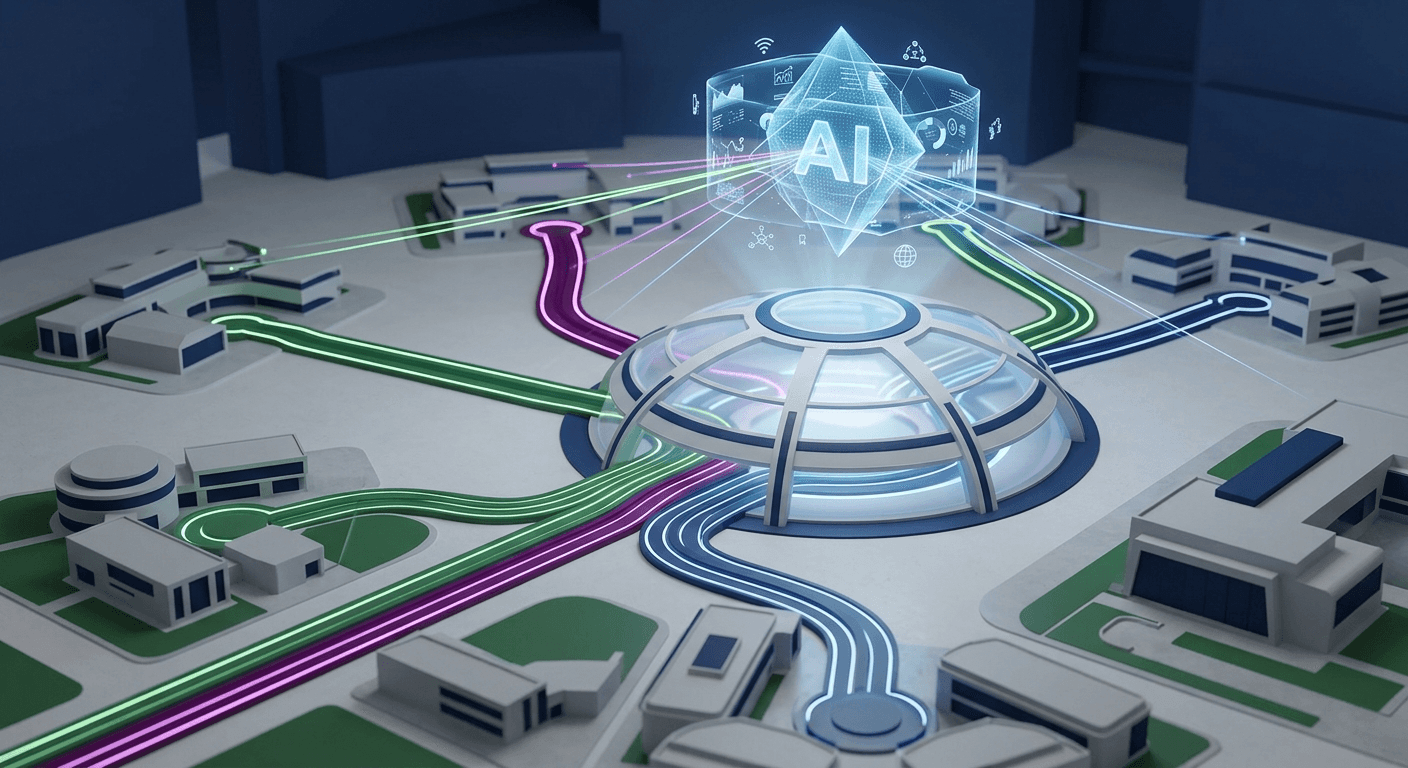
In 2025, the government tabled the most consequential structural legislation in Indian higher education since UGC itself was created: the Viksit Bharat Shiksha Adhishthan Bill (VBSAB) — the law that would dissolve the existing regulatory archipelago (UGC, AICTE, NCTE and their attached bodies) and replace it with a single apex commission and three lean verticals: one for academic standards, one for regulation, one for funding.
The regulatory logic is sound and long overdue: one regulator, one approval ecosystem, lighter touch, single-window governance — the end of the multi-agency maze this series has blamed for years of institutional energy drained into compliance rather than quality.
But buried in the bill's vision is a demand far harder than regulatory plumbing, and far less discussed: the multidisciplinary mandate. NEP 2020 said it, VBSAB operationalises it, and it lands on institutions as a structural earthquake: large multidisciplinary institutions as the norm, clustered campuses, learners moving freely across disciplines and institutions, credits flowing without friction, single-stream colleges transformed or merged into comprehensive universities.
The regulation enabling this can be drafted in a year. The institutions enabling it cannot — and this is the transition's unacknowledged core problem:
Multidisciplinarity is not a permission. It is an operating model. And no Indian institution of the dominant type — the single-stream, department-siloed, faculty-bound college — currently runs one.
A commerce college cannot become multidisciplinary by admitting science students. A university with forty departments that have never shared a course cannot become multidisciplinary by signing a credit-transfer circular. The mandate demands new curriculum architecture, new assessment systems, new advising capacity, new quality controls across disciplines the existing faculty cannot themselves verify — dozens of simultaneous institutional rebuilds, at a scale and pace no increase in administrative staffing could deliver.
This essay is about the migration path: how the intelligence layer this series assembled converts VBSAB's multidisciplinary mandate from an administrative impossibility into an engineered transition — institution by institution, learner by learner.
Why the Mandate Breaks the Existing Operating Model
Run the multidisciplinary requirement through the machinery of a typical Indian institution and it fails at four load-bearing points:
Curriculum doesn't compose. Multidisciplinarity means a learner assembles economics + data science + environmental studies + communication into a coherent degree. But existing programmes are monolithic — built as three-year blocks, not composable modules, with no shared credit semantics across departments. The ABC ledger records credits; nothing ensures the credits add up to something. Composition is a curriculum-engineering problem the syllabus committee model cannot solve.
Advising collapses at the crossing point. The single-stream student's path is pre-laid — the department's syllabus, the department's teachers. The multidisciplinary learner's path is chosen, from hundreds of possible module combinations across departments — and the institution has no advising capacity capable of guiding it. Bad combinations, orphaned credits, and incoherent transcripts are the predictable failure mode; flexibility without guidance produces noise, not breadth.
Quality control loses disciplinary jurisdiction. Under the old model, quality lives inside departments — the physics department verifies physics. When a learner's degree spans four departments and two institutions, who verifies the coherence, the level, the integration? The head-of-department model has no answer; the transcript has no mechanism; the external examiner system breaks entirely.
And the faculty cannot staff the crossings. Genuine interdisciplinary teaching requires faculty who can straddle domains — and the institution cannot hire its way there in a decade, let alone a transition window. Cross-listed courses taught by single-discipline faculty, unverified by anyone who knows both fields, become the multidisciplinary diploma's quiet scandal.
Four structural failures — composition, advising, verification, staffing — each demanding capacity the institution does not have. Each, notably, being a problem this series has already solved in another guise.
The Architecture: The Migration Stack for Multidisciplinarity
1. The modular curriculum engine becomes the composition machine. The two-speed, versioned, module-level architecture — built for currency — is precisely what multidisciplinarity requires: every programme decomposed into granular, credit-semantic modules with defined prerequisites, learning outcomes, and stackability rules. Composition stops being a committee negotiation between departments and becomes a rules-based system: the engine knows which module combinations constitute a valid, coherent degree — which majors pair with which minors, which electives integrate, which combinations are accidental. The institution defines the possibility space once; the machine enforces coherence for every learner individually. VBSAB's free credit flow stops being a ledger function and becomes an architecture.
2. The AI advisor becomes the guidance layer flexibility always lacked. The capability-graph-driven path planning from the counselling essays scales directly: every multidisciplinary learner gets a continuously updated map — your choices so far, the degree configurations they permit, the combinations the market values, the gap between your interest and your trajectory. The learner who wants economics + AI + policy no longer depends on finding a professor who happens to understand all three; the advisor layer composes, checks, and projects the path in seconds, in the learner's language, for every learner — the advising capacity that would require hundreds of human counsellors, provisioned at software cost. Flexibility with guidance, for the first time in the system's history.
3. Verified assessment replaces departmental jurisdiction. The capability graph solves the verification vacuum directly: when modules are independently assessed against defined outcomes — the same tamper-resistant instruments the QA and credit essays specified — a credit means the same thing regardless of which department or institution issued it. The multidisciplinary transcript stops being a list of departmental favours and becomes a verified capability profile spanning sources — legible to employers, portable across institutions, and honest about exactly what was mastered. Verification decouples from location; coherence is proven by evidence rather than asserted by a department head who never saw the other departments' work.
4. AI-assisted interdisciplinary teaching staffs the crossings. The content engine and practitioner-capture layer address the faculty gap: cross-domain modules are built as AI-supported courses — machine-carried content and practice, one human guide overseeing a course they could not have solo-written, verified by external practitioners from the practitioner hybrid who genuinely straddle the fields. An institution without a single faculty member fluent in both biology and data science can now run a bioinformatics module honestly — which is the multidisciplinary mandate's staffing arithmetic, solved.
5. The compliance layer handles the regulator. The quieter gift: VBSAB promises lighter regulation because the regulator expects data it can trust. The continuous-QA telemetry — enrolment, learning gain, outcomes, all streaming automatically — is what makes single-window, lighter-touch oversight administrable. Institutions that instrument themselves earn the light touch; the bill's deregulation and this series' telemetry are two halves of one deal.
The Transition, Managed
The realistic migration is staged, and the stack defines the stages. Phase one — decompose: modularise existing programmes into credit-semantic units; this is unglamorous, unescapable groundwork, and AI-assisted curriculum structuring cuts it from years to months. Phase two — bridge: pilot cross-departmental combinations inside the institution with the advisor and verification layers running; learn locally. Phase three — connect: join the cluster — credit flows with partner institutions under the shared verification regime. Phase four — comprehensive: the full multidisciplinary operating model, with the telemetry feeding the single-window regulator. Institutions that skip decomposition to grab the flexibility headline will generate the incoherent transcripts that discredit the whole reform; the sequence is the strategy.
The Honest Caveats
First, multidisciplinarity can degrade into multiplicity. A menu of unrelated electives is not integration — the goal is learners who connect domains, not tourists collecting them. The composition engine must enforce coherent configurations, and some capstone integration — a project that fuses the disciplines — belongs in every path.
Second, departmental resistance is rational, not obstructionist. Flexibility reallocates students, fees, and power away from the departments that currently own them; expect the politics of entropy. Leadership must pair the mandate with explicit incentive redesign — the faculty catch-up essay's rules apply to structures as much as to skills.
Third, shallow breadth is a real risk for shallow institutions. An institution that cannot staff depth in any discipline will now distribute that shallowness across many — multidisciplinarity as a rebranding of mediocrity. The verification layer is the defence: breadth built on verified outcomes, not on course titles.
The Bottom Line
VBSAB does two things: it collapses a regulatory archipelago into a single regulator, and it demands that institutions built as monastic single-discipline silos become something they have never been — multidisciplinary, composable, learner-directed. The first task is drafting; the second is operations, and it is where the reform will live or die.
The operating model multidisciplinary requires is, precisely, the stack this series has assembled: modules that compose, advisors that guide every learner's crossing, verification that makes credits mean the same thing everywhere, machine-assisted teaching that staffs the domain boundaries, and telemetry that earns the light-touch regulation the bill promises.
The bill will pass, and the mandate will arrive on schedule.
The institutions that survive it will not be the ones that resisted longest —
they will be the ones that decomposed first, and let the machine assemble what committees never could: a university that is genuinely more than the sum of its departments.


© VidyaShift 2026

Where Learning Becomes Opportunity.
An AI-native learning-to-employment company.