The Employer Dashboard: Helping Companies Discover Future-Ready Talent by Quantifiable Readiness Levels
Excerpt: Employers hire the way navies sailed before radar — by reputation, guesswork, and what happens to surface. The intelligence layer gives them something no recruitment function has ever had: a live dashboard of quantified, verified readiness across the entire talent pool — every candidate scored on evidence, every cohort tracked over time, every hire a data point that sharpens the next.
Ask a hiring manager how they currently assess a fresh candidate pool, and behind the polished answer sits the truth:
They hire by proxy and folklore. This college "produces good people." This candidate's résumé "looks strong." This interview "went well." Then the hire lands, and six months later the organisation discovers what a verified capability graph would have stated on day one — often after the candidate has cost a year of salary, a team's morale, and a manager's credibility. Corporate India's talent acquisition runs one of its most consequential decisions — who enters the building — on the least-instrumented information system in the enterprise. Finance got dashboards decades ago. Sales has live pipelines. Supply chains are tracked to the carton.
Talent readiness is still read from a PDF.
This essay completes the hiring-side arc of the series — after discovery, matching, and funnel mechanics — by describing the instrument that makes all of it legible to the employer: the readiness dashboard — a live, quantified, evidence-backed view of the talent pool, in which every candidate carries a verified readiness level, every cohort carries trend telemetry, and every hiring decision feeds data back into a system that gets sharper with each cycle.
What "Readiness" Means When It's Quantified
The dashboard's foundation is a definition the series has built across dozens of essays, now assembled into a single instrument: readiness is not a feeling about a candidate; it is a measured distance between a candidate's verified capability state and a role's verified demand fingerprint.
Each candidate carries a readiness level — computed, not asserted — from three evidence strata:
Verified capability: the graph's assessments — what the candidate has demonstrably mastered, at what proficiency, evidenced by independent instruments rather than claims.
Production evidence: the portfolio and challenge record — what the candidate has built, reviewed, and shipped, including their demonstrated human-plus-AI working fluency, the entry-level essay's core demand.
Readiness behaviours: the mindset layer's telemetry — agency demonstrated across the challenge ladder, persistence through the rejection cycle, professional self-presentation rehearsed to standard. The things interviews used to guess at, now measured along the way.
The composite yields levels employers can act on: not-ready-yet (gaps mapped, paths visible), trainee-ready (capable with structured onboarding), project-ready (able to produce from week one), and hire-ready (verified against this specific fingerprint, with fresh assessment evidence). The levels transform the hiring conversation from adjectives to arithmetic — and, critically, each level is drillable: a not-ready-yet candidate is one 20-hour loop from trainee-ready, and the dashboard shows exactly which loop.
What the Dashboard Shows
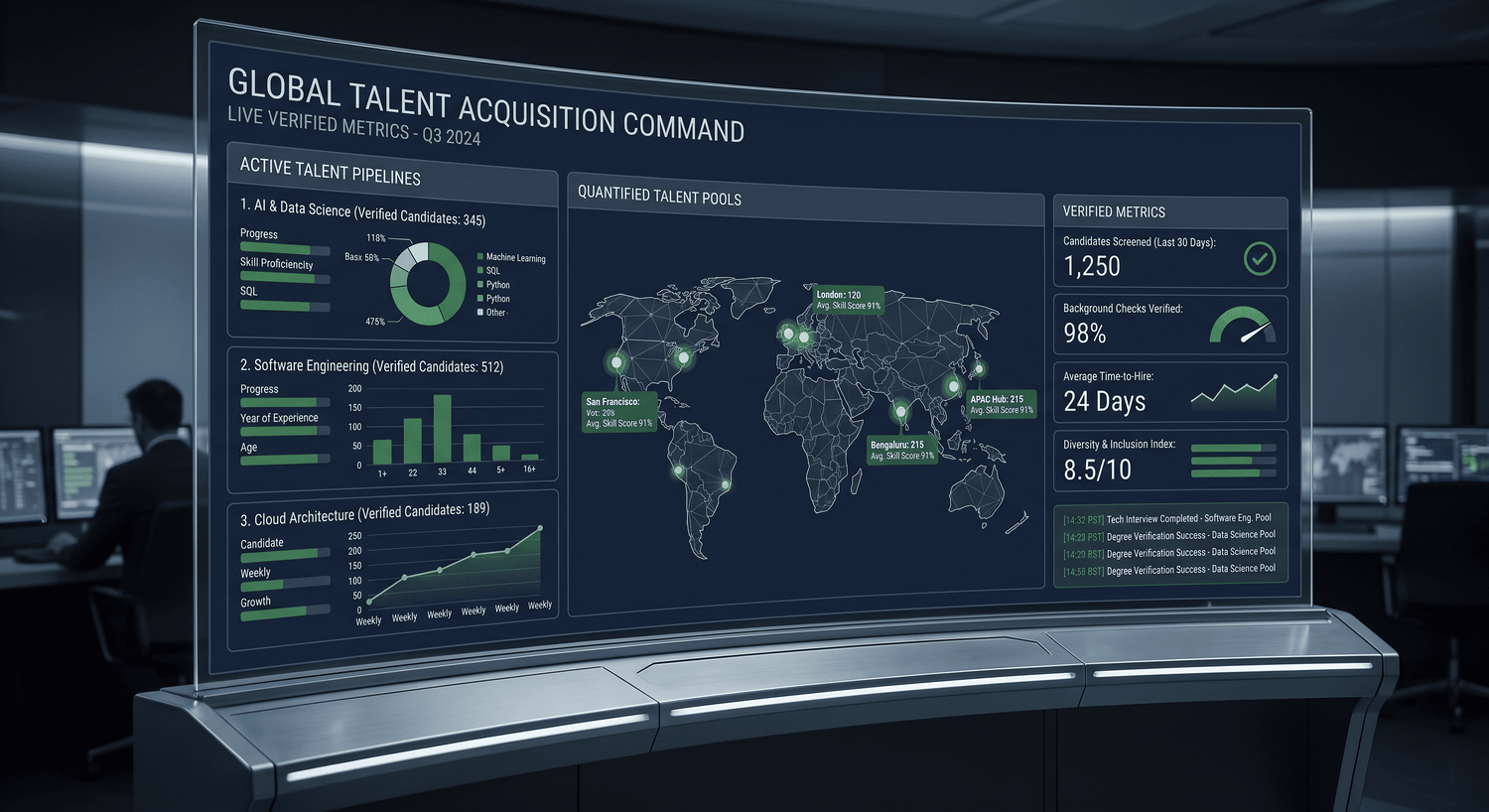
The pool view. Every accessible candidate — applicants, sourced profiles, and graph-holding graduates of partner institutions — plotted by readiness level against the open requisitions' fingerprints. The recruiter stops reviewing documents and starts querying a population: show me every project-ready candidate within 100km of the Pune facility with verified data-analysis capability and trainee-level readiness on the two adjacent skills. Seconds. The funnel essays' machinery, surfaced as a control panel.
The cohort view. For employers with institutional pipelines — campus partners, the CSR skilling cohorts, apprenticeship programmes — the dashboard tracks cohorts over time: this college's current final-years, their aggregate readiness trajectory across the semester, the distribution forming ahead of placement season. The employer watches talent develop like a fund watches positions — and intervenes early: sponsoring a challenge series, offering a practitioner project, flagging the specific capabilities where the cohort lags. Recruitment becomes cultivation, years before the requisition.
The demand view, reflected back. The dashboard also shows employers what the market is pricing: which capabilities in their own requisitions are scarce, which are abundant, where their compensation bands sit against verified supply — intelligence that makes them faster and more realistic in a market where ready candidates expire in weeks.
And the outcome loop — the dashboard's conscience. Every hire is tracked into performance: the six-month and one-year telemetry, consented, feeding back against the readiness scores that predicted them. Which levels actually performed? Which evidence types predicted success, and which looked good and meant nothing? The dashboard calibrates itself against reality — the property no interview panel, no campus reputation, no recruiter intuition has ever possessed. Within a few cycles, the employer's readiness model is fitted not to folklore but to their own hiring outcomes — arguably the first genuinely empirical talent function in their history.
What Changes on Each Side
The employer gets speed and fidelity: shortlists that arrive pre-verified at the target level, interviews reserved for the human judgment machines shouldn't own, onboarding calibrated to the candidate's actual graph (skipping what they've proven, targeting what they haven't), and — the compounding asset — a hiring engine that improves with every cycle instead of resetting with every recruiter.
The candidate is finally priced on evidence. The readiness level is blind to pedigree by construction — it reads the graph, not the college — so the tier-3 graduate who built and verified stands at project-ready beside the metro graduate who coast on a brand, and the dashboard shows them identically. Every proxy the industry used to filter — institution, city, surname — is simply absent from the instrument.
And the institution gains the accountability mirror: its cohorts' readiness distributions, visible to its employer partners, updating each semester. The placement brochure's unverifiable 94% yields to a trendline every stakeholder can watch — the lift-lever and the reputation mechanism in one instrument.
The Honest Caveats
First, a readiness score is a decision instrument, not a verdict on a person. Levels must remain transparent, explorable, and contestable — the candidate must be able to see their score, its evidence, and the path upward. An opaque ranking that sorts people without recourse becomes exactly the gatekeeping this series exists to dismantle, now with better mathematics.
Second, Goodhart's law applies the moment levels gate hiring. If hire-ready status carries reward, the pressure to game assessments arrives immediately; the certification regime from the QA essays — independent instruments, adversarial monitoring, performance-anchored calibration — is load-bearing here too, and the outcome loop is the immune system: gaming that doesn't survive contact with job performance gets priced out within cycles.
Third, dashboards narrow vision as much as they focus it. What is measured gets pursued; the unmeasured — curiosity, integrity, the qualities that make a colleague worth a decade — risks invisibility. The levels must be understood as floor instruments, establishing capability legibility, with the human judgment layers explicitly reserved for everything the graph cannot hold.
The Bottom Line
Corporate India hires tomorrow's performance using yesterday's instruments — proxy, reputation, and a thirty-second résumé skim — and pays for the gap in mis-hires, missed candidates, and a talent market where pedigree outshouts evidence.
The readiness dashboard replaces the instruments: verified capability, production evidence, and readiness behaviours, computed into transparent levels; pools and cohorts visible live; calibration against real outcomes cycle after cycle. Hiring becomes what every other core enterprise function became when it got instrumented — faster, fairer, and progressively smarter.
Talent has always been the resource every company claims to prize most.
This is what it looks like when a company finally builds the dashboard that proves it —
a hiring function that doesn't guess who's ready, because it can see.


© VidyaShift 2026
Where Learning Becomes Opportunity.
An AI-native learning-to-employment company.