
Behavioural Alignment: Overcoming Anxiety with Psychometric Diagnostics and Mindset Recalibration
Excerpt: We diagnose learning gaps with dashboards and skill gaps with assessments — then send the anxious learner into the same exam hall and wonder why they underperform. Anxiety is measurable, mappable, and trainable. It's time it entered the learner graph.
Consider two students, statistically identical.
Same marks, same attendance, same capability graph, same coaching. Both sit for the placement interview season. One converts three offers. The other — knowing identical amounts, tested at identical levels — blanks in the group discussion, freezes in the technical round, and spends the summer hearing "good candidate, didn't perform."
Everyone around the second student offers the same explanation, delivered with a shrug: "He's nervous." As if anxiety were a personality trait to be accepted, like height. As if nothing could be done.
But "nervous" is doing enormous hidden work in Indian education's outcome data. Anxiety is the unmeasured variable corrupting every measurement the system makes: the exam score that reflects panic management as much as physics knowledge, the interview that tests composure as much as competence, the course abandoned not from inability but from the specific dread of feeling stupid in public. A learner can hold perfect capabilities on paper and lose every high-stakes moment to the machinery of their own threat response — and the education system, having built dashboards for every other gap, has no instrument for this one.
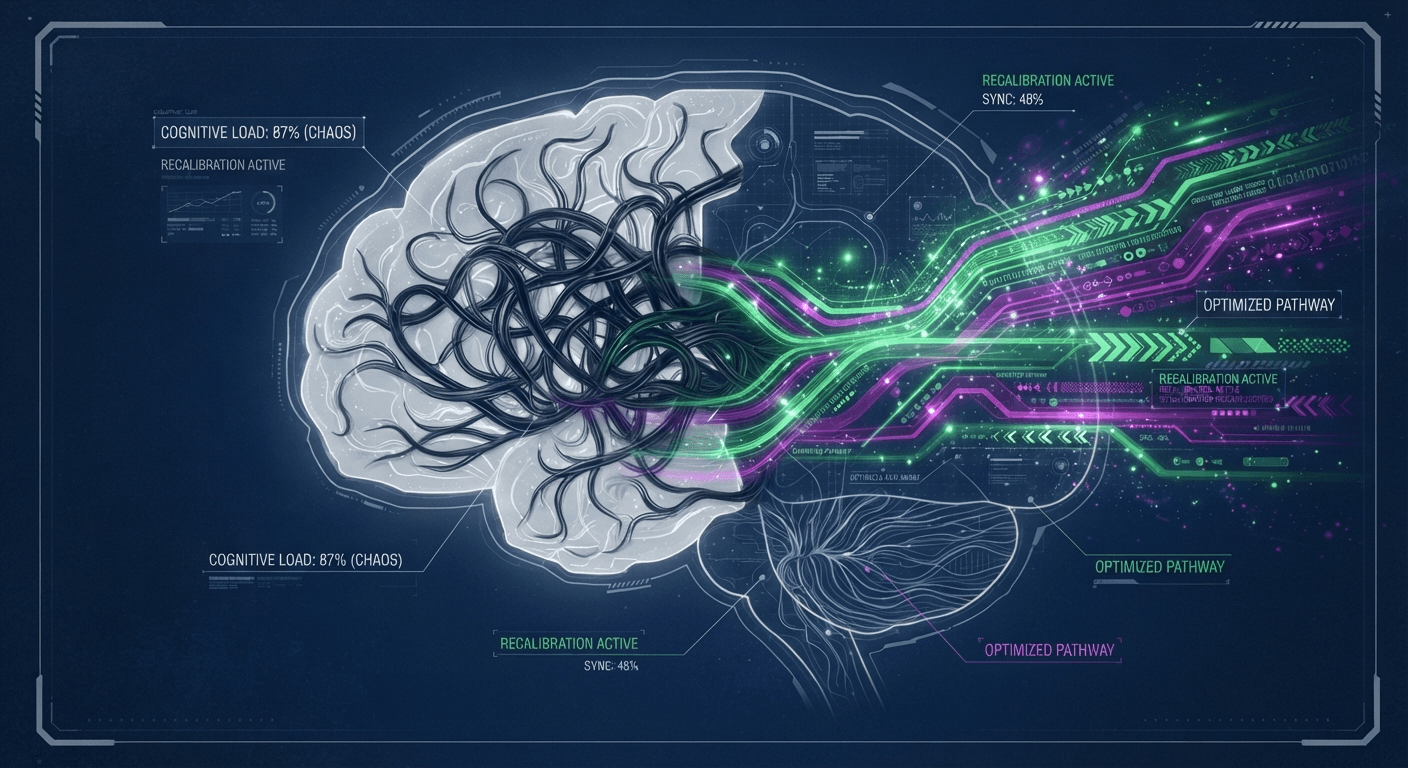
That instrument now exists. Psychometric diagnostics can map an individual's anxiety profile with precision — where it fires, what triggers it, how it manifests — and a century of psychological science offers recalibration protocols that reliably reduce it. This essay is about wiring both into the learning system: behavioural alignment — the practice of diagnosing the learner's psychological machinery and training it as deliberately as we train their skills.
Because the final gap in any learner is rarely knowledge.
It's the state they're in when it counts.
What Anxiety Actually Does to a Learner
Anxiety isn't a mood — it's a cognitive event with measurable mechanics, and its mechanics are educationally devastating:
Working memory gets hijacked. Test anxiety research is unambiguous: anxious learners devote a significant share of their working memory to monitoring the threat ("I'm failing, everyone else is fine, this matters enormously") — memory that isn't available for the actual problem. The anxious student isn't worse at mathematics; they're doing mathematics with half the RAM. This is why the anxious underperform relative to their own verified capability — the gap between tested ability and demonstrated performance is, substantially, an anxiety tax.
The cycle self-reinforces. Anxiety impairs performance; impaired performance confirms the fear; the fear strengthens before the next stakes event. Left alone, this spiral converts a normal, trainable nervousness into a chronic identity ("I'm just bad at exams") — the fixed mindset that decades of research show is itself a learned, and unlearnable-able, state.
It fires selectively. Crucially, anxiety is not a global condition. One learner blanks in written exams but is fluent in interviews; another is the exact inverse. One freezes when watched; another when timed; another when the outcome is public. A generic "be confident" intervention treats a fingerprint with a bucket of water — which is why generic interventions fail.
And avoidance keeps it alive. The anxious learner skips the mock interview, delays the practice test, avoids raising their hand. Each avoidance delivers momentary relief and pays in capability: the exact exposures that would extinguish the fear are the ones the fear prevents. Left to itself, anxiety engineers its own permanence.
The training implication is exact and hopeful: since anxiety is specific, its diagnosis must be specific — and its treatment must be graduated exposure with feedback, the single most validated mechanism in all of behavioural psychology.
Diagnosing the Pattern: The Anxiety Profile
The psychometric layer of this series' stack — built for predictive placement — extends naturally to the behavioural domain. A learner's anxiety profile combines:
Validated instruments. Standardised scales for test anxiety, social-evaluative anxiety, and perfectionism — brief, multilingually validated, administered like any other diagnostic in the onboarding flow.
Behavioural telemetry from the learning system itself. The at-risk dashboard's signals, reread through a behavioural lens: the learner who aces AI-practiced problems alone but skips every live doubt session; whose assignment timestamps show panic-cramming; whose mock-test scores swing wildly against stable practice scores; who withdraws precisely when assessment becomes visible to peers. The pattern — performance diverges sharply by stakes and by audience — is itself the diagnosis, visible in data the institution already collects.
The situational map. The output is not a label ("anxious") but a map: exam-type anxiety, high; social performance anxiety, moderate; time-pressure anxiety, low; public-failure sensitivity, high. Four learners with identical "anxiety" need four different recalibration plans — and now have them.
Recalibration: Training the Response, Not Reassuring the Symptom
Mindset recalibration is not motivational content — posters and pep talks have never survived contact with an exam hall. It is skills training for the physiological and cognitive response, delivered through the same architecture as every other intervention in this stack: graduated loops, instant feedback, AI practice at zero marginal cost, humans at the moments that matter.
Cognitive reframing, trained not told. The core techniques — cognitive reappraisal ("this racing heart is readiness, not doom" — arousal reinterpretation, robustly validated in performance research), attention redirection, self-talk restructuring — are taught as micro-skills and practiced in simulation: the AI layer runs mock exams and mock interviews calibrated to escalate stakes gradually, and the learner rehearses the reframe in the moment, with feedback, the way they rehearse any other skill.
Graduated exposure, engineered by the machine. The avoidance problem is solved the way the tutoring layer solves everything: by making the feared thing small, frequent, and safe. A learner with interview anxiety doesn't start with a panel — they start with an AI-conducted mock interview alone, then an AI interview with follow-up pressure questions, then a small human session, then the real thing. Each rung is achievable; each completion rewrites the prediction ("I survived; I even improved"); the spiral runs in reverse. The AI layer's contribution is decisive here: exposure practice requires dozens of repetitions, which no human interviewer could ever supply and no anxious learner would ever request — but a tireless, non-judging, always-available AI interviewer supplies at zero cost, without the social humiliation that makes human practice impossible for the anxious beginner.
Psychological safety as infrastructure. Two of the most consistent findings in performance science belong in every classroom's design: writing about worries before a high-stakes event measurably frees working memory — a ten-minute, zero-cost protocol deployable before every exam; and learners perform to the way ability is framed — taught as growable, they persist; framed as fixed, they defend. Institutions anxious about anxiety should audit their own rituals: public rank lists, humiliating remedial batches, "who didn't clear" roll-calls — the average Indian institution runs an anxiety-manufacturing plant and calls it discipline.
The human at the threshold. As everywhere in this series: the AI runs the repetitions; the human delivers the moments. The mentor who says "here's your data — your practice scores are excellent, your interview scores will converge, here's the plan" replaces the anxiety narrative with evidence. And the profile has gates: anxiety is a trainable behavioural pattern, but clinical-level depression or disorder is a medical matter — the diagnostic layer must refer, not treat, with counsellors wired in as the escalation path.
The Compounding Payoff
Aligned learners don't just stop underperforming — they unlock every other intervention in this series. The at-risk dashboard's flags stop being missed because avoidance-driven disengagement is caught at the behavioural source. The capability graph stops understating people. The predictive-placement go-to-market stops mislabeling anxious-but-capable candidates as weak. Placement conversions climb disproportionately at the middle and bottom of the confidence distribution — exactly where the series' equity commitments live. And the skill trained — performing under evaluation — never expires: it transfers to every interview, every appraisal, every high-stakes moment for the rest of a working life.
The Honest Caveats
First, the goal is regulation, not elimination. Moderate arousal improves performance — the aim is calibrated response, and a system that medicates all stress away produces fragile performers. Train the response; keep the edge.
Second, this domain is where data ethics bites hardest. A learner's psychological profile is the most sensitive record in the entire stack — more than marks, more than skills. It must be consent-gated, learner-owned, invisible to employers and recruiters in any transferable form, and used exclusively for the learner's benefit. The moment an anxiety profile leaks into hiring triage, the tool becomes a sorting machine — the line this series has never crossed and will not now.
Third, diagnosis without delivery breeds cynicism. Measuring anxiety and then offering a PDF is worse than not measuring. The recalibration loops take design effort and integration with the actual learning calendar — mock schedules, pre-exam protocols, mentor scripts. A psychometric programme is an operating change, not a questionnaire.
The Bottom Line
Indian education measures knowledge exquisitely and ignores the state of the mind holding it — then attributes every gap between the two to character. Anxiety is not character. It is a specific, diagnosable, trainable pattern with known mechanics: hijacked working memory, self-reinforcing fear, engineered avoidance — and known antidotes: graduated exposure, cognitive reframing, psychological safety, evidence over narrative.
The stack this series built now closes its most human gap: diagnose the anxiety profile alongside the skill profile; train the response with the same loops, feedback, and AI patience that train the skills; put the human mentor at the moment where belief is the intervention.
Every exam hall and every interview room already sorts learners twice — once by what they know, once by what their nervous system does under pressure. The first sorting is measured, coached, and celebrated.
It's time the second one was too.


© VidyaShift 2026

Where Learning Becomes Opportunity.
An AI-native learning-to-employment company.