The Practitioner-Faculty Hybrid: Involving Industry Ecosystems Directly in Personalized Tutoring
Excerpt: The gap between what classrooms teach and what industry does is never closed by syllabus committees — it's closed by practitioners. The problem was always scale. AI just solved it: one practitioner can now tutor a thousand learners.
Ask an employer what's wrong with Indian graduates and you'll hear one complaint more than any other: "They've never seen the real thing."
The graduate can define a database but has never debugged a production system serving real users. The MBA can recite pricing theory but has never defended a price against a procurement officer. The civil engineer knows the codes but has never watched a slab being poured at 6 AM, or argued with a site supervisor about tolerance. The knowledge is present; the situation is missing. And classrooms cannot manufacture situations they've never lived.
Every decade, education reformers point at this gap and propose the same remedy: bring industry practitioners into teaching. Guest lectures. Adjunct appointments. Industry visits. And every time, the remedy dies on the same three rocks: practitioners can't leave work on weekdays, faculty jobs don't accommodate full-time professionals, and one practitioner's scarce hours spread across a classroom of sixty amounts to a sip of relevance in an ocean of theory.
For a century, practitioner involvement has been structurally impossible at scale. What changed is that AI solved the scale problem — and with it, the possibility of a genuinely hybrid faculty: the academic professor who owns pedagogy and depth, and the industry practitioner who owns currency and reality, both amplified by the intelligence layer into cohorts neither could serve alone.
Why Practitioners Are the Missing Nutrient
The capability gap graduates carry is specific and diagnosable: it isn't missing content — content is what classrooms deliver abundantly. It's three things only practitioners carry:
Situated judgment. Textbooks teach rules; practice teaches exceptions. Why the "correct" solution fails at this client, under this deadline, with this legacy codebase. The tacit knowledge that never appears in any syllabus because nobody can articulate it — only demonstrate it.
Current reality. Practitioners know what this week's toolchain looks like, what employers are actually screening for, and which "best practices" have quietly died. The curriculum-at-AI-speed essay argued institutions need live market signals; a practitioner is the signal, walking and talking.
Credibility that transforms motivation. A classroom teacher says "this matters." A working engineer says "I used this on Tuesday, and here's what went wrong." The effect on learner motivation — especially for first-generation learners with no industry family network — is not marginal. It is frequently the moment abstract study becomes a career. Practitioner contact is not content delivery; it's evidence that the destination is real.
The vision of practitioners embedded in education is old and noble — the NEP explicitly calls for industry teaching involvement. What's failed, every time, is the delivery model: the guest lecture, one hour, forty students, question-and-answer cancelled for lack of time. The industry's knowledge enters the classroom at the rate of a visitor's schedule, and evaporates by the exam.
The Hybrid Architecture: Practitioners at AI Scale
The intelligence layer this series has built changes the economics of practitioner involvement from unscalable to compounding. Three mechanisms do the work:
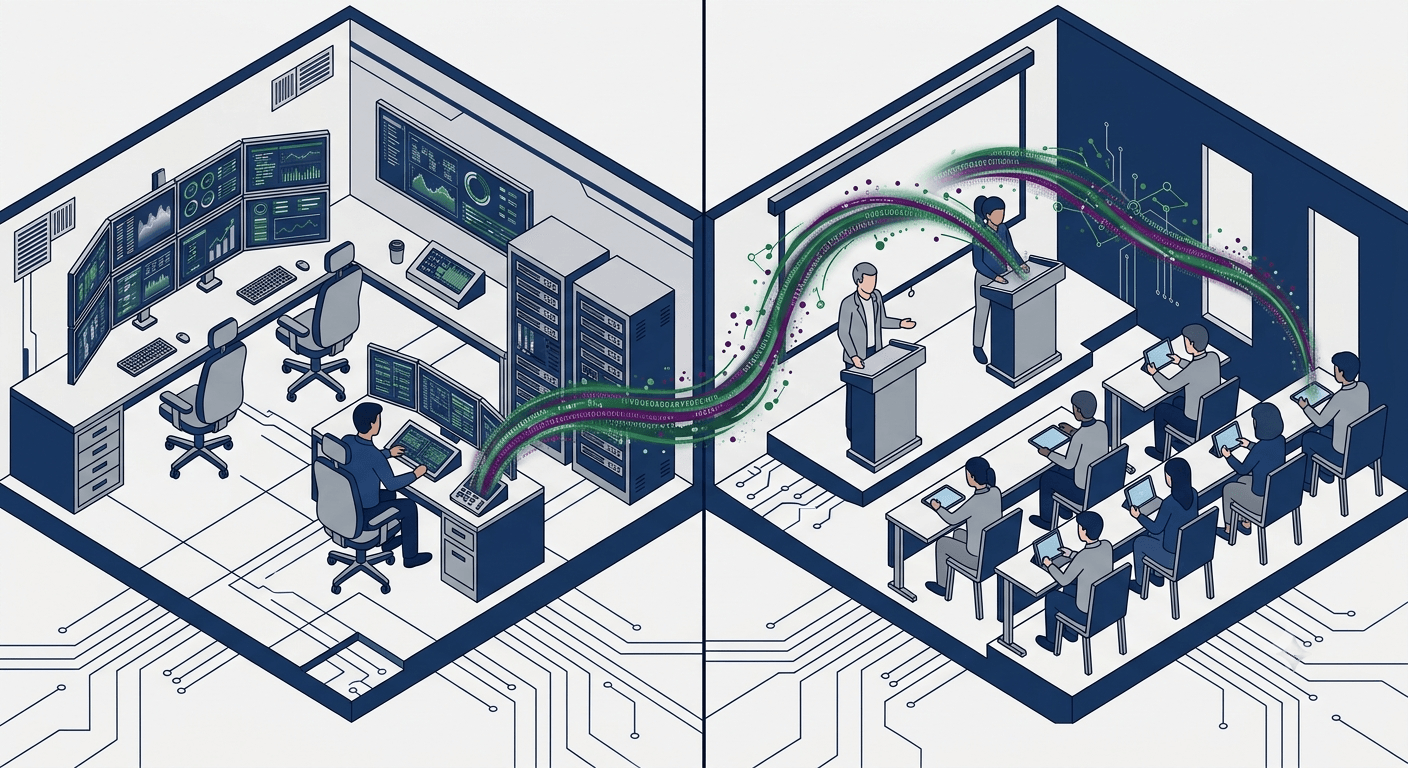
1. The practitioner knowledge capture. This is the quiet breakthrough. A practitioner's scarce hour — spent once, not repeated — is recorded inside the learning system: a recorded case walkthrough, a worked problem from their actual work, an annotated failure story, an interview about how the job really runs. AI then does what it does at near-zero marginal cost: it embeds that material into personalized learning. The practitioner's case study becomes the worked example in an adaptive module. Their war story becomes the context of a practice problem. Their debugging of a real failure becomes the scenario in an AI tutor's Socratic dialogue — the machine asks the learner the questions the practitioner would ask.
The consequence inverts the guest-lecture arithmetic: one captured hour now reaches every learner in the cohort — and every future cohort — inside their individual learning path. The practitioner's presence is no longer a visit; it's an ingredient, continuously served, at machine scale. A single practitioner hour may touch a thousand learners across a year, personalized for each.
2. AI-mediated live interaction. When the practitioner does spend live hours — an office hour, a project review — the AI layer makes those hours count. The learner graph routes each practitioner-hour to the learners whose profiles and projects most need it; the AI pre-briefs the practitioner on each learner's work and specific confusion (the same briefing architecture as the hybrid counselling model). No hour is spent on "what have you done so far" — the machine already knows. Practitioner time becomes pure high-value interaction: judgment, critique, war stories, real-time problem dissection.
3. The practitioner-graded real task. The deepest integration: learners' capstones and projects are set from real industry problems — a practitioner's dataset, their company's actual workflow, their genuine evaluation criteria. AI assesses the routine dimensions against the rubric; the practitioner reviews the finalists' work — an hour evaluating ten AI-pre-screened submissions, the machine having already carried the hundred routine reviews underneath. Real tasks, industry evaluation, human attention at the moments that matter: this is the apprenticeship signal, manufactured at scale.
What Each Side Gains
This hybrid is not charity in either direction — it's a trade in which both sides capture genuine value.
The learner gains what no single model provides: the professor's systematic depth (the slow core of fundamentals, protected from fashion) and the practitioner's current reality (the fast layer, personified). Theory meets situated judgment. Motivation meets evidence. This is Bloom's two-sigma tutoring made possible partly by AI's cost curve — and made real by the practitioner's presence inside it.
The academic faculty gain currency without leaving campus: practitioner material keeps their modules current, their projects authentic, their market-signal loop fed by someone who doesn't need a committee to know what the market wants. The two-speed curriculum gets a human fast lane.
The practitioner and their employer get something hiring pipelines rarely deliver: a direct view of pre-verified talent. The practitioner who teaches a cohort sees its capability graphs before any recruiter does; their employer essentially runs a low-cost, high-fidelity pipeline into the exact skills it needs. Teaching becomes recruitment; the classroom becomes the pre-hire relationship. Companies that get this early will skim the best talent from institutions before competitors even see the resumes — and the best practitioners become talent magnets in their own right, their personal brands compounding with every cohort they touch.
The institution gains what no accreditation can confer: verified market relevance, delivered weekly, inside the learning itself.
The Honest Caveats
First, practitioners are not teachers, and the model must not pretend otherwise. Practitioner expertise is not pedagogy; a brilliant engineer may explain nothing clearly. The hybrid's division of labour exists precisely for this — the professor and the learning system carry pedagogy, the practitioner carries reality — and institutions must resist the cheap temptation to substitute practitioners wholesale for faculty. The hybrid works because neither side plays both roles badly.
Second, capture is the bottleneck, and capture takes effort. A rushed recording of a screen-share is not embedded knowledge. Extracting a practitioner's tacit judgment into usable, personalized learning material is skilled instructional work — usually done by AI plus instructional designers working from the practitioner's raw hour. Institutions that skip this step get marketing videos, not tutoring. The capture pipeline is the real build.
Third, extraction risk cuts both ways. A practitioner whose employer's confidentiality is breached by a case study creates legal catastrophe; a learner whose "exposure" is really unpaid shadow-work creates exploitation. Live projects inside courses need explicit scope, IP clarity, and genuine learning value — the internship-void lessons from earlier apply in full. And the equity caution stands: if practitioner access flows mainly to premium cohorts, the hybrid deepens the divide the whole series has fought. It must be architected into the base programme, not sold as an add-on.
The Bottom Line
For a century, the question "who teaches?" has had only one acceptable answer — the full-time academic — with one supplement, the occasional guest, priced beyond reach at any scale. The result is a standing gap between classroom and practice that every employer complains about and no syllabus committee has ever closed.
The practitioner-faculty hybrid closes it by refusing the old trade-off between depth and currency: the professor owns the pedagogy, the practitioner owns the reality, and the AI layer makes one hour of either reach a thousand learners in personalized form. Practitioner knowledge gets captured once and served everywhere; practitioner hours get routed to the interactions where human judgment matters most; practitioner employers get a talent pipeline measured in relationships, not resume piles.
The guest lecture was always industry visiting education — briefly, politely, and then leaving.
The hybrid makes industry live in education — inside the modules, the tutor conversations, the projects, and the feedback — at a scale where its effect stops being a highlight of the semester and becomes the texture of the whole curriculum.
Classrooms teach what is known.
Practitioners carry what is happening.
The hybrid learner finally gets both — and for the first time in the history of mass education, at the same table.


© VidyaShift 2026
Where Learning Becomes Opportunity.
An AI-native learning-to-employment company.