NEP 2020: Vision to AI Reality
Excerpt: India's most ambitious education policy was finalised twenty-eight months before the technology that could deliver it existed. NEP 2020 specified the destination with uncanny accuracy — and shipped without an engine. The engine has since arrived
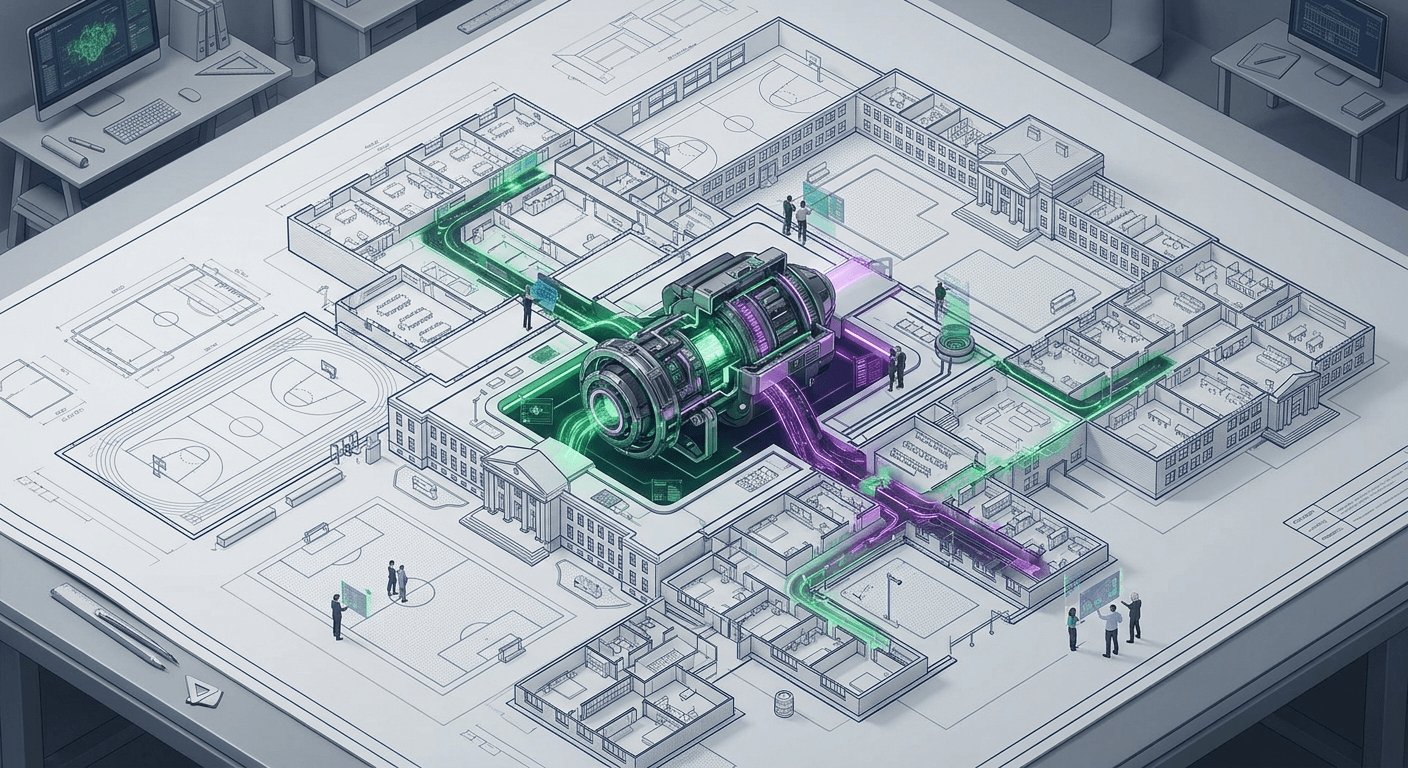
On 29 July 2020, India unveiled the National Education Policy — the first full rewrite of the nation's education philosophy in thirty-four years. Its drafts were closed, and the policy signed, in a world where "educational technology" meant smartboards, MOOCs, and attendance apps. Twenty-eight months later, ChatGPT ignited the era this series has documented — and with it, capabilities the policy's own authors could describe only as aspiration.
Five years on, the scorecard is familiar: frameworks legislated, portals launched, nomenclature changed — and classrooms recognisably the same. Multiple entry-and-exit exists in regulation and rarely in practice. The Academic Bank of Credits runs, and few learners move. Holistic progress cards are piloted; holistic teaching is unchanged. The mother-tongue mandate is litigated; the multilingual classroom is unstaffed.
This is not a failure of intent. It is a category mismatch. NEP 2020 is, structurally, a specification document: it describes the properties the system should exhibit — personalization, flexibility, multilingualism, competency — without supplying the machinery that produces them. And a specification without a processor is a paperweight. The policy did not fail its implementers. It simply preceded them.
The previous essay in this series took NEP's boldest number — the 50% GER target. This essay takes the policy whole, and argues a single claim: every major pillar of NEP 2020 now has a working AI counterpart, most of them built earlier in this series. The vision needs no revision. It needs realisation.
Why the Vision Stalled: Every Pillar Is Labour-Intensive
Read the stalled pillars side by side and one property unites them: each demands a volume of personalised, human-scale work the system was never staffed to perform.
The 360-degree holistic progress card requires each teacher to assess sixty students across cognitive, affective, and psychomotor dimensions — from a teacher already rationed at one hour per student per week. Mother-tongue instruction requires staffing every subject, in every region, in every home language — an administrative impossibility no budget has ever touched. Foundational literacy requires teaching thirty children who sit in one classroom at five different reading levels — which is asking one human to be five teachers at once. Vocational exposure requires practitioners to appear — the three rocks from the practitioner-hybrid essay, unchanged since the 1960s.
NEP's genius was seeing what the system must become. Written before AI, it could only gesture at how — devoting a chapter to technology, imagining a national forum, and assuming digital tools would assist teachers. Assistance was never the bottleneck. Substitution of repeatable labour was — and in 2020, no policy could name a machine that could do it.
The Great Translation: Every Pillar Meets Its Engine
Lay the policy's pillars against the stack this series has assembled, and the mapping is almost one-to-one:
Holistic, competency-based assessment → the capability graph. NEP demanded the death of rote measurement and the birth of multidimensional learner records. Manually generated, these are fantasy at a 1:60 ratio; generated as a by-product of continuous AI assessment, they are free. The 360-degree card stops being a reporting burden and becomes what the learning system already produces daily — and board-exam stakes fall naturally, because verified evidence exists every day, not one terrible morning.
Mother tongue multilingualism → the polyglot tutor. The three-language controversy was always, underneath, a staffing war — no state can hire every subject in every tongue. AI makes language a setting, not a syllabus battle: the same concept served in the learner's home language, the teacher supported in theirs, one classroom, many languages, no hiring queue.
Foundational literacy and numeracy → adaptive mastery. NIPUN Bharat's goal — every child reading and computing on time — collides with the multigrade reality of Indian classrooms. The adaptive engine is precisely the machine for this: diagnose each child's actual level, serve each child at that level, report the gaps daily. The one-teacher-five-levels problem is, finally, an engineering problem with an answer.
Flexibility — multiple exits, credit mobility → the modular curriculum engine. Credits don't flow because monolithic programmes don't compose. The two-speed, versioned, module-level architecture makes the Academic Bank of Credits a working marketplace rather than a ledger: courses stack, transfers port, the ladder from certificate to degree becomes real for the working learner NEP claims to serve.
Vocational integration → the practitioner hybrid. NEP wants vocational exposure from school onward; the delivery problem is ancient. Captured practitioner hours embedded in learning paths, 20-hour challenge loops, industry-graded real tasks — the exposure NE mandates, delivered to everyone rather than rationed to whichever school found a friendly factory.
The reborn teacher → the augmented educator. NEP's most repeated sentence — the teacher is the heart of the system — sits beside fifty new duties assigned to the same teacher. The leverage essay resolves the arithmetic: AI absorbs the repeatable labour, the teacher is returned the hours for the human work the policy actually describes. And NEP's commitment to continuous professional development stops being the annual compliance workshop, because AI delivers personalised teacher training at scale — for the first time making the policy's teacher vision affordable rather than merely admirable.
Equity for disadvantaged groups → personalization plus retention. NEP devotes its longest equity sections to learners the uniform system sorts by prior advantage. Personalization is equity's operational form: the at-risk dashboard catching the first-generation learner's silent withdrawal in week three, the capability graph admitting those the paperwork system discarded.
What Reality Requires: The Rails
Vision-to-reality translation has governance preconditions, and they are specific. Data protection first: NEP's holistic records are the most sensitive dataset the system will hold, and the DPDP framework must be operationalised for learners — consent-gated, learner-owned, purpose-limited. Quality gates second: the national accreditation of AI content and assessment validity standards, without which the market will happily sell "NEP-aligned" fluency that teaches nothing. And speed third: the policy took thirty-four years to be rewritten; its implementation will now face eighteen-month technology cycles. Regulation must run on the two-speed clock — stable principles, fast-cycle updates — or it will either strangle the engine or chase it uselessly.
The Honest Caveats
First, the tech-washing risk is already here. Legacy content rebranded "AI-powered, NEP-compliant" is the sector's easiest sale and the vision's quietest betrayal. The test of realisation is never compliance logos; it is the outcome data — learning gains, retention, placements — measured the way this series has insisted on measuring everything.
Second, AI can betray NEP's equity spirit while executing its letters. If polyglot tutoring reaches the connected and adaptive Foundational Literacy and Numeracy (FLN) misses the child without a device, the engine will widen the exact gap the policy was written to close. Shared-device models, offline capability, and vernacular model quality are not implementation details — they are the mission itself.
Third, "holistic data" can drift into the panopticon. A 360-degree record of every child, collected carelessly, is surveillance with a policy citation. The behavioural-alignment essay's line holds at national scale: measure to help, consent to collect, and never let the holistic card become a sorting instrument.
The Bottom Line
NEP 2020 is the rare policy that read the future correctly and arrived too early. It specified personalization before machines could personalise, multilingualism before translation was free, competency before assessment could be continuous, and flexibility before curriculum could compose. Then it handed this specification to a system without the labour to execute any of it — and five years of stalled frameworks followed.
The engine the policy couldn't name now exists, and it is built from exactly the parts this series assembled. The distance between India's education vision and India's classrooms was never comprehension.
It was capacity.
Capacity just became software — and the policy that preceded its implementers is finally, for the first time, implementable.


© VidyaShift 2026
Where Learning Becomes Opportunity.
An AI-native learning-to-employment company.