The Institutional Turnaround Rescuing India's Distressed Private Colleges Without Bloated Marketing Budgets
Excerpt: From Tamil Nadu to Uttar Pradesh, thousands of private colleges are bleeding seats and cash. The rescue instinct — spend more on marketing — is exactly wrong. Here's the playbook that works.
Travel through the highway belts of Tamil Nadu, Maharashtra, or the NCR and you'll see it physically: private engineering colleges with sprawling campuses, half-empty classrooms, and faded admission banners promising "100% placement." India has roughly 40,000 colleges, and a large share of private ones are running persistent deficits, carrying unsold seat capacity — some engineering institutions couldn't fill even 40-50% of their sanctioned seats — and servicing debt taken on to build infrastructure for a demand wave that has already passed.
The default rescue playbook is familiar and almost always wrong: hire an admissions agency, buy student "leads," flood Instagram and Google ads, pay agents per enrolled student. Marketing and admissions-agent costs at distressed institutions routinely devour 15–25% of revenue — money extracted from exactly the teaching quality that caused the decline in the first place.
There is a better path. It treats the institution not as a brand problem but as an asset problem — and it starts with understanding why the institution got distressed in the first place.
Why Institutions Sink: It's Rarely the Brand
A distressed Indian private college almost always follows the same arc.
Phase one: launch with a scarce, hot degree and harvest the demand wave — engineering in the 2000s, MBA in the 2010s, B.Pharma and B.Sc nursing more recently. Phase two: the model gets copied by hundreds of competitors, politicians and real estate groups enter the sector for the land and cash flows, and the degree's scarcity premium collapses. Phase three: enrolment falls, but fixed costs — buildings, staff, loans taken at 11–14% from NBFCs — don't. So the institution cuts spending on the only thing that matters, instruction, to protect debt service and marketing. Faculty quality drops (adjuncts, visiting "faculty" who don't exist on the rolls), labs go unupgraded, placements soften.
Then comes the fatal move: spending more on marketing to fill seats in a weakening product. This is arithmetically sustainable for about three admission cycles. After that, the institution is paying agents increasingly to bring in students whose poor outcomes poison the very word of mouth the marketing was bought to replace. It's a doom loop: marketing spend rising, product quality falling, net enrolment shrinking.
The core diagnostic insight: distressed Indian colleges are almost never short of leads. They're short of reasons to be chosen — and increasingly, short of a cost structure that would let them offer one.
The Asset Audit: What You Actually Own
Before spending a rupee, a turnaround must inventory the real balance sheet — including assets that don't appear on it:
Physical assets: land — often the single most valuable item, frequently bought cheap decades ago — plus buildings, labs, hostels running at 40–50% utilisation. Licenses: AICTE/UGC/PCI approvals and NAAC grades are genuinely valuable, perishable, and often carelessly maintained until renewal season. Faculty remnants: the few genuine teachers left are the seed of the rebuild. Alumni data: thousands of graduates scattered across IT services, pharma, banking — a dormant distribution network almost never systematically engaged. The affiliation franchise: for colleges affiliated to state universities, autonomy and new-structure programmes are underused weapons.
The turnaround question is never "how do we sell what we have better?" It's "what do we have that the market currently underprices — and how do we redeploy it?"
The Five-Lever Playbook
Lever 1: Cut the Cost Base AI-First, Not Staff-First
The reflexive cost cut in Indian colleges is faculty — which guarantees quality collapse and accelerates the doom loop. The smarter sequence: strip the repeatable, expensive, low-variation work out first. Adaptive AI learning platforms can carry explanation, practice, assessment, and doubt-clearing in Hindi, Tamil, Telugu, or English at a fraction of the cost of marginal adjunct hires. This lets a distressed institution hold or improve learning outcomes while cutting instructional cost per student by 30–50% — the only cost cut that doesn't feed the death spiral. It also fixes the dirty secret of Indian private colleges: ghost faculty kept on paper for affiliation compliance while teaching runs thin.
Lever 2: Sell the Surplus, Not the Degree
Half-empty campuses are stranded capacity with fixed costs. Instead of discounting seats in dying B.Tech programmes, monetise what the market actually wants: hostels and classrooms leased to coaching operators, skilling partnerships PMKVY and state skill missions, corporate training programmes, testing centres, allied-health and paramedical courses using existing labs, international pathway programmes with foreign university. Every square foot that earns revenue without adding degree-cost pressure directly attacks the deficit.
Lever 3: Programme Surgery — Kill, Convert, Create
Most distressed colleges are running 2009's portfolio in 2025. The turnaround requires brutal triage: kill programmes with structurally demand (the 300-seat mechanical branch getting 40 takers), convert capacity to where scarcity still persists — healthcare and allied health, pharmacy, data and AI, agriculture technology, trades-plus-degree hybrids — and create only where the institution has a genuine edge: proximity to a manufacturing cluster, a hospital tie-up, one star professor. One strong, honestly marketed programme outperforms twenty weak ones.
Lever 4: Outcomes Transparency as a Competitive Weapon
Here's the counterintuitive move. Distressed colleges can't outspend the brands on marketing, but they can out-disclose everyone. Publish the median placement salary (not the one ₹44 LPA outlier), audited percentages with definitions, actual faculty credentials, fee-all-inclusive costs. Indian higher education runs on inflated brochures and fake "100% placement" claims that AICTE has repeatedly tried — and failed — to police. Radical honesty is the only differentiator money can't buy, and it costs but courage. Parents comparing two ₹2-lakh options increasingly trust audited data over hoardings.
Lever 5: Recruit the Alumni Army
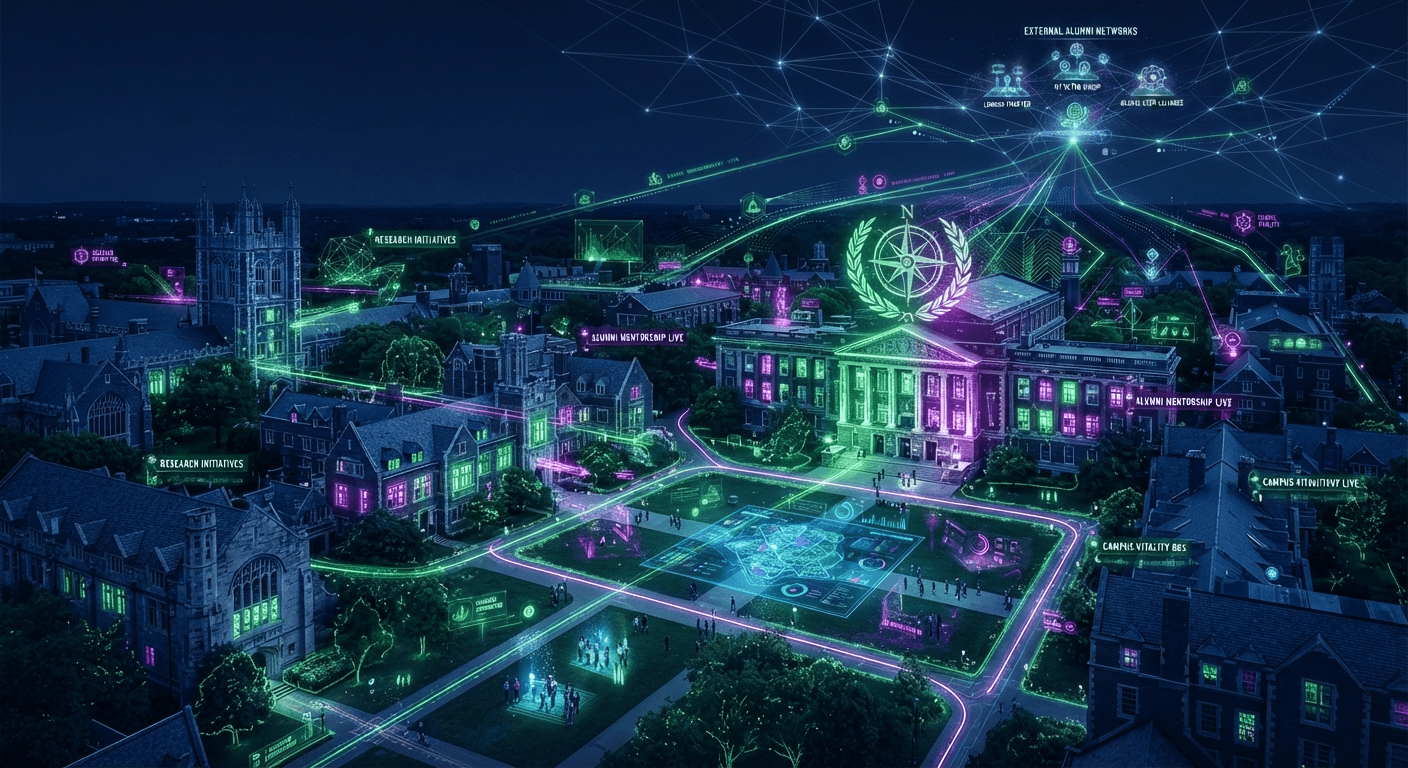
The cheapest enrolment channel that exists is a satisfied alumnus in a Tier-2 town telling a neighbour's kid the truth. A systematic alumni engine — mentorship, referral networks, hiring pipelines back into campus placements — converts a dormant asset into a distribution channel at near-zero marginal cost. No admissions agent can replicate word of mouth from someone with nothing to gain. In India, where the family decision is shaped by "kisi ko pata hai is college ke baare mein?", this is the single highest-ROI move available.
The Honest Caveats
Three hard truths about turnarounds.
First, some institutions shouldn't be saved. If the location is wrong, the land value exceeds the going concern, and demand for every programme is structurally dead, the responsible outcome is orderly closure, merger, or conversion — returning students to better institutions and redeploying the land. Turnaround romanticism wastes resources; several hundred Indian engineering colleges are zombies kept alive by loan forbearance and compliance theatre.
Second, governance is usually the disease. Trust-run institutions treating the college as a real estate play or a political asset, founder families interfering in admissions and appointments, and cash capitation flows can't be fixed by any operating playbook. If ownership won't professionalise, nothing else works.
Third, the turnaround window is two admission cycles. Once local perception flips from "aspirational" to "avoid, my cousin went there decline compounds faster than reform. In Indian admissions, reputation moves at the speed of the neighbourhood, and timing matters as much as strategy.
The Bottom Line
The distressed Indian college's instinct — buy visibility for a weakening product — is the exact inverse of what works. Visibility without substance just accelerates reputational collapse at higher cost, which is precisely what a decade of admissions-agent economics has produced.
The working formula inverts the spend: AI carries the instructional cost curve down, surplus campus assets generate non-degree revenue, the programme portfolio gets surgical, transparency replaces the agent network, and alumni replace the ad agency.
The deeper point mirrors this entire series: Baumol's economics made education expensive, and distressed colleges are where that bill finally came due. AI-driven cost redesign means an institution that teaches better can now also cost less — for the first time in Indian higher education, the affordable option and the good option can be the same college.
Rescue isn't about shouting louder on a highway hoarding. It's about rebuilding the product until the truth is worth marketing — and telling the truth costs almost nothing.


© VidyaShift 2026

Where Learning Becomes Opportunity.
An AI-native learning-to-employment company.