The Capability Graph: Measuring What a Learner Can Demonstrably Do Across Their Journey
Excerpt: Resumes claim, transcripts imply, degrees vouch — but nothing proves. The capability graph replaces all three with verified evidence of what a learner can actually do.
Ask any employer in India what a B.Tech degree tells them about a candidate, and you'll hear the same weary answer: that the candidate sat through semesters. Ask what the marksheets tell them, and the answer is darker: almost nothing they can trust. Marksheet inflation, college variation, and the total absence of skill verification have created a hiring market where the credential signals almost nothing — so 73% of Indian employers, by industry survey estimates, deploy their own tests anyway, re-assessing every graduate from scratch.
The failure isn't just hiring inefficiency. It's a lifetime of misallocated trust: students optimise for marks instead of ability, colleges optimise for placement statistics instead of capability, and the entire education economy runs on documents that describe — but never demonstrate.
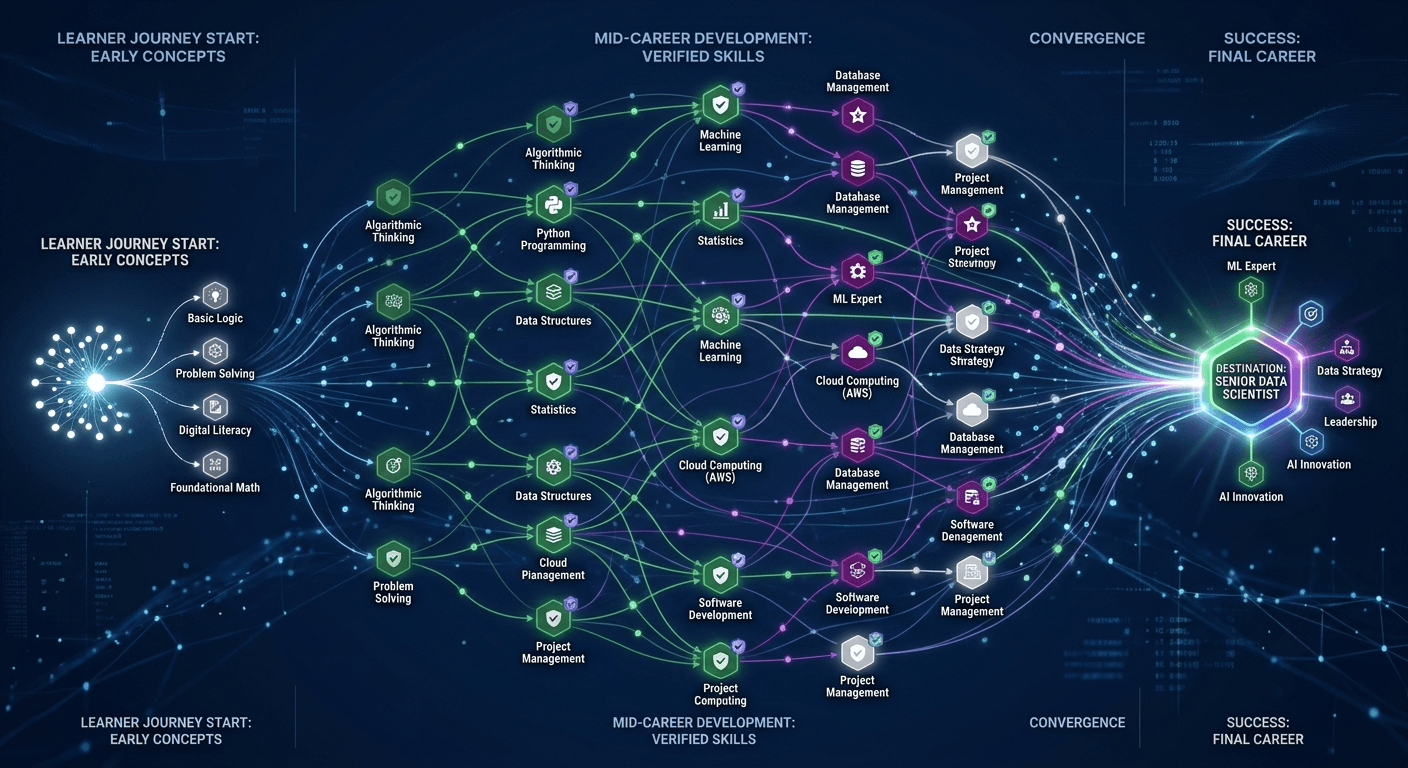
What's missing is a fundamental redesign of the unit of measurement. Not the transcript, which records courses completed. Not the certificate, which asserts attendance. But the capability graph — a living, verified map of what a learner can demonstrably do, built across their entire journey, from first concept to final job.
Why Every Current Measure Fails the Same Test
Run each existing credential through one question — does this prove capability, or merely claim it? — and the whole stack collapses.
Marks measure compliance, not competence. A semester exam captures one day's recall performance, under one format, assessed by one examiner with one rubric. It cannot distinguish a student who genuinely understands data structures from one who memorised the night before. And it decays without trace: the 85% scored in Semester 3 tells an employer nothing about what remains in Semester 8.
Degrees measure endurance, not ability. Eight semesters survived says something about persistence — valuable, but coarse. A first-class from one college and a pass class from another can represent identical actual capability; employers know it, which is why the college's brand, not the learner's record, does the real signaling.
Resumes measure confidence, not skill. "Proficient in Python" is an unverifiable sentence. Every recruiter knows it. The resume is essentially a self-published advertisement that everyone reads with a mental discount of 50%.
Interviews measure performance under one hour of pressure. One conversation, one mood, one sample of one day — generalised into an irreversible hiring decision.
The common defect: all four are point-in-time assertions, unverifiable, non-cumulative, and disconnected from the actual work a person will be hired to do. What's needed is the opposite: continuous, cumulative, evidence-based, work-relevant.
What the Capability Graph Is
A capability graph is a structured, evolving record built on three primitives:
1. Capabilities, not courses. The graph's atoms are verifiable competencies — granular and demonstrable: "can write a recursive function," "can read a balance sheet," "can communicate an analysis in writing," "can debug a failing test under time pressure." Not "completed CS201." A course passes; a capability shows. Thousands of such atoms, mapped to industry frameworks, form the vocabulary.
2. Evidence, not assertion. Each capability node is linked to the artefacts that prove it: project submissions, code repositories, recorded presentations, assessment performances, internship work products, verified apprenticeship outcomes. Evidence types can be weighted — a proctored assessment counts differently from a classroom quiz, a real employer project differently from a mock. The graph doesn't say "s SQL." It says: here are the four work products where SQL was used, here's how they were assessed, here's the trajectory.
3. Time, not snapshots. Because the graph is cumulative, it captures what transcripts never could: growth, decay, and trajectory. A learner whose debugging capability climbed steadily over three years reads differently from one who spiked before placements. Capabilities that lapse become visible — triggering re-verification rather than hiding behind a four-year-old credential. The graph is less a report card than a longitudinal ECG of ability.
Connect the three primitives and you get the graph's real power: inference across nodes. Knowing a learner demonstrably holds twenty related capabilities lets the system estimate adjacent ones, recommend the shortest path to a target role ("you're four verified capabilities away from data-engineering-ready"), and match to opportunities with precision no resume ever achieved. For the learner, the graph becomes a career navigation system. For the employer, it becomes a trust machine: verified evidence instead of discounted claims.
Why Now: The Rails Already Exist
Three shifts make the capability graph buildable today when it was fantasy a decade ago.
AI makes assessment continuous and cheap. The historical barrier to capability verification was cost — one examiner per exam. AI assessment can evaluate code, writing, reasoning, and spoken communication per interaction, at near-zero marginal cost, generating evidence as a by-product of learning rather than a separate examination event. The tutoring layer from this series and the assessment layer are the same investment.
India's digital public infrastructure provides the substrate. APAAR ID, DigiLocker, and the Academic Bank of Credits were built for exactly this: portable, verifiable, learner-owned records. The capability graph is the semantic layer those rails were missing — the difference between storing documents and storing demonstrated ability.
Employers are deserting degrees anyway. The world's largest IT firms have already dropped degree requirements for many roles in favour of skill assessments; global capability centres hire on verified capability because their global parents do. The demand side has moved. The credential supply side just hasn't caught up.
The Honest Caveats
First, capability graphs can become surveillance dressed as assessment. Capturing evidence "continuously" across a learner's journey slides easily toward monitoring everything, always. The graph must record work products and demonstrated competencies — not behaviour, attention, or personality telemetry. The healthcare-AI lessons from earlier apply with full force: learner data is sacred, consent is real, and the learner — not the institution — should own and port the graph.
Second, graphs can harden into new tracking systems. If an algorithm decides at fifteen what capabilities a learner is "on track" for, we've rebuilt streaming with better mathematics. The graph must remain an open map — showing every possible pathway — never a prediction engine that quietly closes doors. Adapt support, never ambition.
Third, evidence quality is the whole game. A graph filled with gamed micro-credentials and AI-generated project artefacts is worse than a resume, because it claims verification. Guarding the graph requires proctored or portfolio-defended evidence for high-stakes claims — and the willingness to let some capability remain unmeasured rather than fake-measured.
The Bottom Line
Every credential humanity has ever issued for learning shares one flaw: it substitutes a document for a demonstration. The capability graph ends the substitution. It says: don't tell me what course you did — show me the work, verified, cumulative, current.
For learners, it converts effort into portable, provable assets that appreciate across a lifetime. For employers, it replaces the discount-laden resume with a trust machine. For institutions, it forces — and rewards — the outcome honesty series has repeatedly called for: you can't fake a capability graph, which is exactly why it will be fought.
The degree answered one question: did you sit through it?
The transcript answered another: did you pass the exam?
The capability graph answers the only question that ever mattered, from the first classroom to the final job:
What can this person actually do — and can I see the proof?


© VidyaShift 2026

Where Learning Becomes Opportunity.
An AI-native learning-to-employment company.