
Outcome First, Method Second: Moving Beyond Pure Physical and Pure Digital Education
Excerpt: India's education debate is stuck between classroom romantics and edtech evangelists. Both are answering the wrong question. Outcomes should choose the method — not ideology
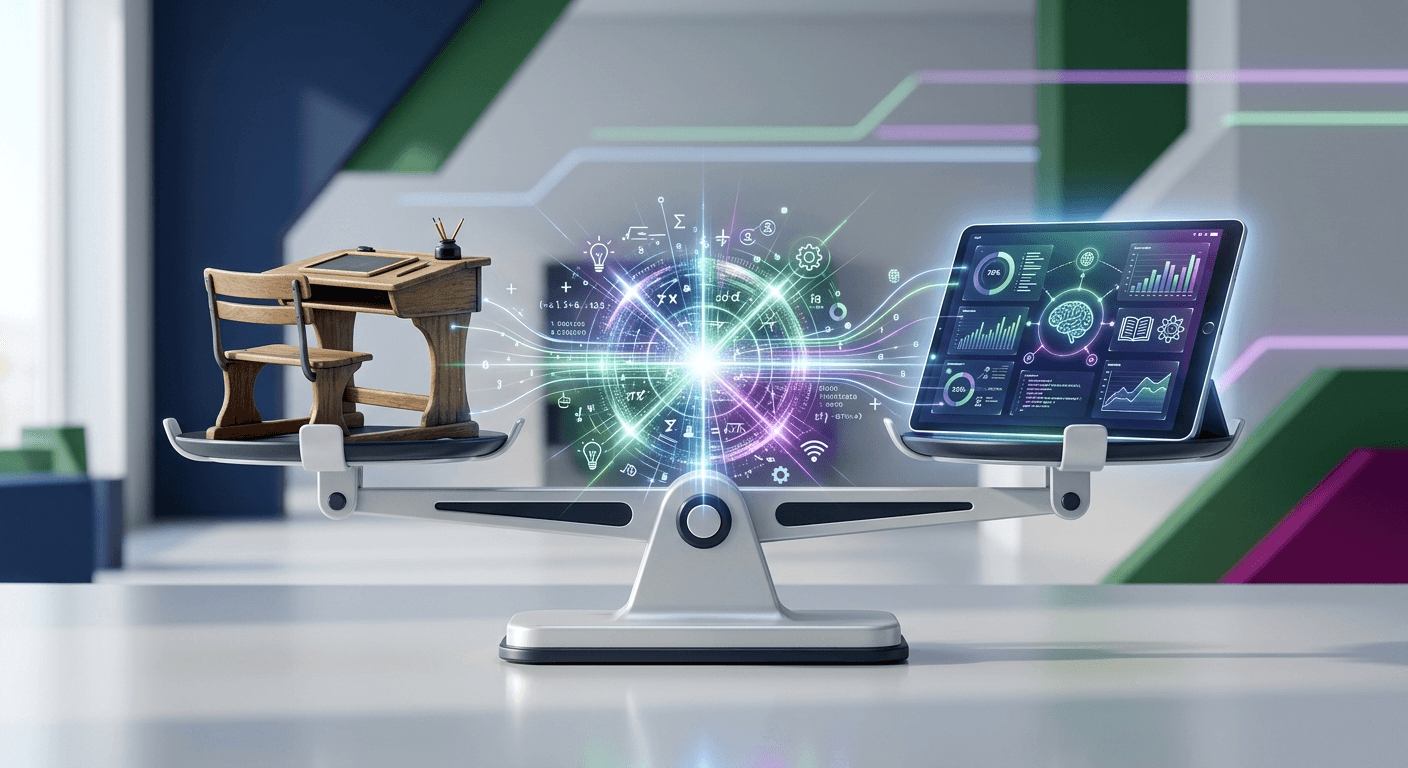
India's education discourse is trapped in a war between two tribes.
The first tribe worships the physical classroom. "Screens are destroying children," they say. "Nothing replaces a guru. Learning happens in relationships, in playgrounds, in the discipline of showing up." This camp includes most traditional schools, teacher unions, and a large share of parents whose own schooling shapes their instincts.
The second tribe worships the digital. "The classroom is a 19th-century factory model," they say. "Personalised AI, recorded lectures, learning apps — scale knowledge to a billion children at the cost of a data pack." This camp includes most edtech founders, policy technocrats, and investors.
Both tribes are convinced the fight is about method. Both are wrong. The fight was never about method — and the moment you judge education by outcomes instead of delivery formats, the entire debate reorganises itself.
The False Binary That Cost Us a Decade
Consider what each purity has actually delivered.
Pure physical, at scale in India, means one teacher for 60 children in a multi-grade classroom, rote transmission, zero personalisation, and the ASER finding we've normalised into background noise: most Class 5 students cannot read a Class 2 text. The classroom's defenders are defending an ideal that exists only in elite private schools with 1:15 ratios — a model that, by Baumol's economics, can never scale to 250 million children. Pure physical, for the vast majority of Indian children, is a euphemism for rationed attention.
Pure digital got its full, unmixed trial during COVID — and the verdict was devastating. The ASER 2021-22 surveys documented children dropping out of learning entirely: no device, no data, a shared phone belonging to a father who took it to work. Even among connected households, a child watching a video is in a one-to-zero relationship with the material. Byju's — once India's most valuable startup and the flagbearer of pure digital — collapsed under the weight of its own sales machinery, having sold tablets and subscriptions while learning outcomes remained unmeasured and often unimproved.
So the scorecard reads: pure physical fails by scarcity, pure digital fails by absence. One starves learning of attention; the other starves it of humanity. And the most important word in Indian education — access — punishes both purities: the village child with a bad school and no device falls through both at once.
The Question That Reorganises Everything
Strip away the ideology and ask the only question that matters:
For this child, this subject, this stage — what combination of human and machine delivers the best measurable learning outcome per rupee?
Notice what changes when outcomes go first.
Suddenly, the classroom isn't sacred — it's a tool with strengths and costs. It's superb at supervision, socialisation, routine, and safety; it's terrible at personalised pacing. Suddenly, the screen isn't evil — it's a tool too. Superb at infinite patience, diagnosis, and practice; terrible at knowing when a child's silence means confusion rather than comprehension — or hunger.
The method debate dissolves into a division-of-labour question. And the evidence from India's own experiments already sketches the answer.
What the Evidence Actually Says
The digital-first flip: IIT Madras' online BS degree now enrols more students than most physical IITs combined — with proctored rigor and real outcomes — proving that for motivated older learners, digital-first is not a compromise but an upgrade. But note the precondition: motivated learners. Digital-first works when self-regulation already exists.
The blended government-school wins: recent AI tutoring pilots in Indian government settings — and the World Bank's Nigeria results that developing-world policymakers study closely — show the pattern: AI handles practice, feedback, and doubt-clearing; the teacher handles what only humans do. Learning gains arrive not despite the teacher, but because her scarce hours are concentrated by technology onto the children who need her most.
The coaching industry's secret: every serious coaching institute already runs blended — physical batches plus recorded lectures, test series apps, doubt-solving platforms. They never ideological about purity; they optimise ruthlessly for the outcome that pays them: rank. The market's highest-stakes segment already voted against both purities.
The failure mode both tribes share: any configuration — physical, digital, or blended — that doesn't measure learning gains is flying blind. The pandemic's deepest lesson wasn't about screens or classrooms. It was that most of Indian education had never rigorously measured outcomes, so when delivery broke, nobody knew what had been lost until two years later.
The Outcome-First Framework
Operating outcome-first requires four discipline shifts:
1. Define the outcome in measurable terms before choosing the method. Not "quality education" — but "child reads a Class 2 text by Class 3," "student clears JEE Main cutoff," "graduate passes a defined employability bar." Vague outcomes let every method claim victory.
2. Treat physical and digital as budget lines, not identities. A school asking "how much screen time?" is asking an identity question. Asking "which 40% of instructional hours does software handle measurably better, freeing teachers for the rest?" is asking an outcome question. The answers differ per subject, per age, per child — which is precisely why ideology can't set them.
3. Let the youngest be the most physical. The one defensible generalisation from the evidence: early childhood learning is heavily relational — language, attachment, behaviour. Digital belongs at the margins there. As learners mature and motivation stabilises, the digital share should rise, not as ideology but as economics. A rigid formula is wrong; a gradient is right.
4. Measure ruthlessly, in the child's own context. A blended model that shows gains in Bengaluru but not Bhandara isn't validated. Outcome-first means accepting that the same method can genuinely work in one context and fail in another — and letting the data, not the brochure, decide.
The Honest Caveats
Three confessions from the outcome-first side.
First, measurement itself can be gamed. Teach to the assessment and you'll show gains that evaporate. The fix is measuring durable, transferable skills — not just the module just completed.
Second, outcomes-first sounds neutral but shifts power to whoever defines the metric. If the metric is only employability, we risk crushing everything education does beyond jobs — citizenship, curiosity, character. The outcome list must be as broad as education's purpose.
Third, blended done badly is worse than either purity. Screens bolted onto bad teaching to cut costs, with no measurement — that's the wrapper tax in a new costume. Purity at least has the honesty of commitment. Blended demands more design discipline, not less.
The Bottom Line
The physical-versus-digital war is a category error dressed as a philosophy debate. Classrooms and screens aren't competing worldviews — they're inputs with different costs, different strengths, and different failure modes.
Ask "physical or digital?" and you get ideology. Ask "what does this child need to learn, what does it cost, and which mix delivers it?" — and the answer changes per subject, per age, per district, per rupee. That answer-driven flexibility is not a compromise between the two tribes. It's the adulthood that comes after both of them.
India cannot afford either romance: not the nostalgia of the idealised classroom it can't scale, nor the techno-utopianism of the app that assumes a device, a connection, and a self-driven child that millions don't have.
The method is a servant. The outcome is the boss.
Hire accordingly.


© VidyaShift 2026

Where Learning Becomes Opportunity.
An AI-native learning-to-employment company.