
Automating the Intervention: Using Dashboards to Identify At-Risk Learners Before Final Exams
Excerpt: Every institution discovers its struggling students at the final exam — when it's too late to help them. The data to see them coming in week three already exists. It's just lying around unwatched.
Here is the cruellest ritual in Indian education, repeated across every exam season:
A student fails. The post-mortem begins. The teacher recalls — with genuine anguish — "she was always quiet in class." The attendance register shows the absences started in October. The internal marks were sliding since the first test. The doubt she never asked was the one the whole unit was built on.
Every signal of failure was present, visible, and recorded — months before the exam. Nobody was watching.
This is the structural tragedy of learner risk: failure almost never arrives unannounced. It sends memos for months — slipping quiz scores, thinning attendance, unanswered doubts, assignments submitted at 2:59 AM, withdrawal from peer groups. The traditional classroom simply has no mechanism for reading them. One teacher, sixty students, registers and marksheets reviewed at term-end: the memos pile up unread until the failure itself is the notification.
Now flip forward a few years, to a system where the signals are read in real time — and the intervention happens in week five, not after the results. This essay is about that flip: automating the intervention — using live dashboards to surface at-risk learners while there is still time to change their trajectory, and wiring the human response so the dashboard saves people instead of merely predicting their collapse.
Why the Current System Is Blind by Design
The traditional institution detects failure through three instruments, each broken in a specific way:
The attendance register — reviewed monthly at best, acted on never. By the time chronic absence triggers a letter, the academic damage is a semester deep.
The internal assessment — two or three checkpoint exams per term, results returned weeks later, and interpreted as grades to record rather than signals to investigate. A 34% in the first internal test is a diagnosis delivered in October and ignored until March.
The teacher's attention — the only real-time sensor in the system, and it's rationed at sixty students to one pair of eyes. Teachers do notice struggling students — the quiet ones at the back are noticed constantly — but noticing without data is intuition without evidence, and one teacher's attention across sixty students is triage without a queue.
The deeper failure is conceptual: institutions treat failure as an event to be graded, not a process to be interrupted. The exam is the event; the process — disengagement, accumulating gaps, silent withdrawal — runs for months, entirely off the radar. Every failed student is a process that nobody interrupted.
What the At-Risk Dashboard Actually Sees
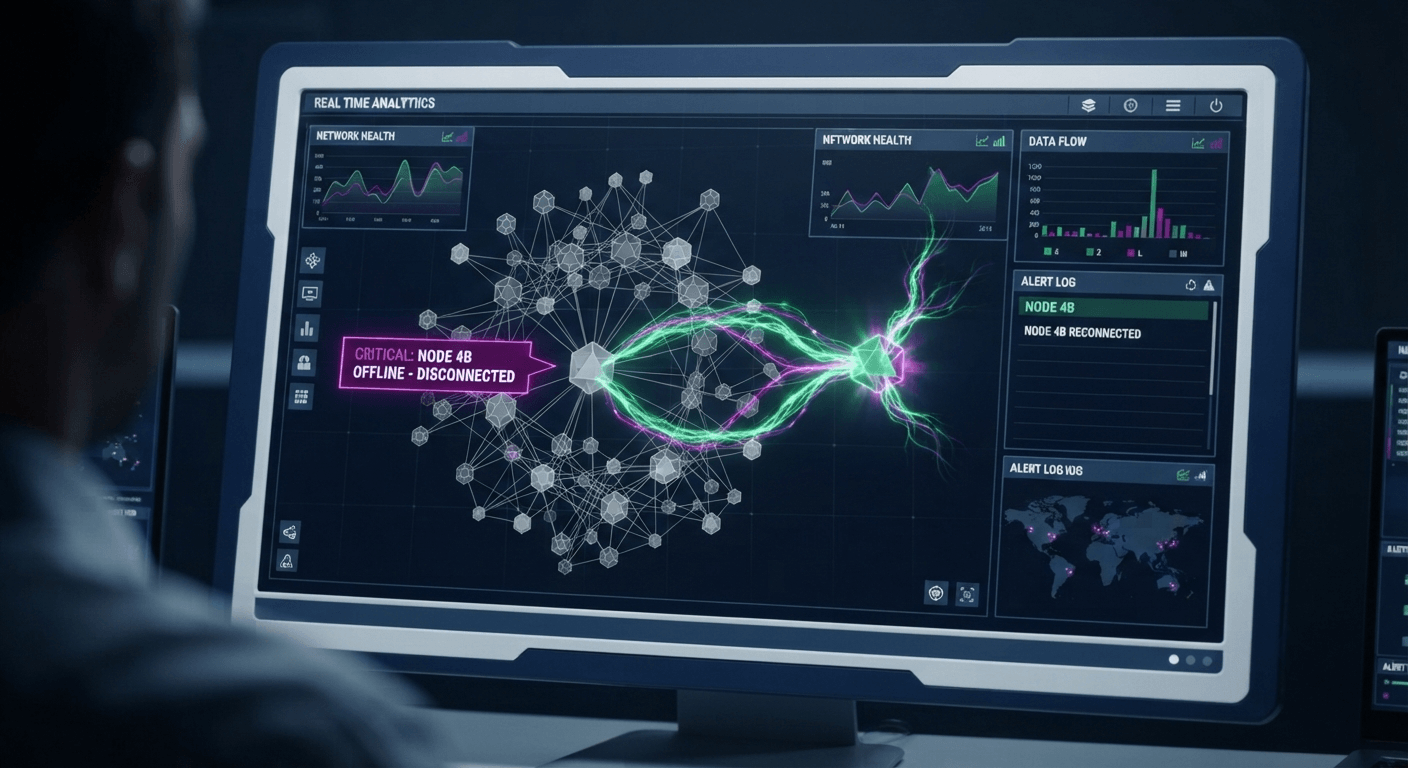
The intelligence layer this series has built — AI tutoring, continuous assessment, the learner graph — turns the classroom into a readable system. The dashboard aggregates the failure memos into a live risk picture:
Engagement decay. Login frequency dropping, session length shrinking, practice attempts falling off — visible in days, not months. Digital disengagement precedes academic failure by weeks; it is the earliest measurable memo.
Mastery gaps accumulating. Continuous assessment (the by-product of AI-delivered learning) reveals not just that a learner is failing but where the failure began — the Class 8 ratio weakness beneath the Class 11 calculus collapse, flagged the week it starts compounding. The diagnostic trail is the dashboard's superpower: it doesn't just ring the bell, it names the leak.
Assessment trajectory. Not the absolute score but the slope — a consistent 70% scorer sliding to 62% then 55% is a louder alarm than a stable 50%. Decline is the signal; the marksheet only records the landing.
Behavioural composites. Assignments submitted late-or-never, doubt-asking frequency dropping to zero,forum silence, assignment timestamps migrating to last-minute. Each is weak alone; combined, they form the risk fingerprint the teacher's intuition senses but can't articulate.
Life-signal proxies. Fee payment delays, hostel absences, sudden withdrawal across all subjects simultaneously — often signals of trouble at home, financial distress, or mental health deterioration, which no amount of subject tutoring will fix.
The output is a ranked, living queue: not "results at term-end" but this learner, this week, these specific gaps, this recommended action. The teacher's sixty-student attention problem inverts — the machine watches everyone and escalates the few, so scarce human attention lands where it changes outcomes.
The Hard Part: Wiring the Intervention
Here is the uncomfortable finding from every early-warning deployment worldwide: dashboards that predict failure and do nothing else predict failure very accurately. The notification is not the intervention. Institutions that bought screens and saw no outcome change learned — expensively — that the value lies entirely in the response loop:
Every flag must map to a named human action. Not "monitor" — call the learner this week; schedule the diagnostic session; loop in the mentor. The dashboard generates a work queue, and the queue is worked like any operational pipeline, with owners and deadlines.
Interventions must be tiered to the diagnosis. A mastery gap gets an AI-prescribed remediation path plus a tutor check-in. An engagement collapse gets a human conversation — because disengagement is usually a motivation or life problem wearing academic clothes. A life-signal composite gets the counsellor or the welfare officer, not extra problem sets. Prescribing worksheets for a depression signal is the classic failure of naive deployments.
The loop closes back into the data. Every intervention is recorded, and its effect on the learner's trajectory is measured — the outcome-intelligence discipline applied to the rescue system itself. Over cycles, the institution learns which interventions actually work for which risk patterns — and the playbook compounds the way every other layer of this series compounds.
The AI does the follow-through, the human does the moment. The hybrid model from earlier applies fully: AI administers the remediation (the practice, the re-explanations, the mastery checks at 11 PM) at near-zero cost, while the human delivers the one thing machines can't — "I noticed. I'm asking. I'm here." For many at-risk learners, that sentence is the intervention; everything else is scaffolding around it.
What It Changes
The measurable pattern from institutions that wire this properly: catchment rates and pass rates rise most dramatically not at the top — whose students were never at risk — but in the middle band: the learner who would have scraped 45% or quietly failed, retrieved to 65% because someone saw the slide in week four. Retention improves, backlogs shrink, and — the quiet institutional win — the final exam stops being a surprise for everyone involved.
This is also, notably, the cheapest outcome lift in this entire series. The signals already exist in every institution's systems — registers, LMS logs, assessment records — currently unwatched. The dashboard doesn't create data; it reads what's already there. Against the cost of remedial batches and failed semesters, automated early warning may be the highest-ROI intervention in education.
The Honest Caveats
First, risk scores can become self-fulfilling prophecies. A learner labelled "high risk" who receives lower expectations and a demoralising conversation from the flag is harmed, not helped. The dashboard must drive support, never streaming, and the conversation must be framed as "we noticed, how can we help" — not "the system says you'll fail."
Second, surveillance creep is the ever-present temptation. The same logs that catch disengagement can monitor every keystroke a learner makes — and some vendors sell exactly that. The healthcare-AI ethics of this series apply in full: collect what predicts and helps, not everything collectable; tell learners what's watched and why; and keep the mental-health proxies in human hands, governed by consent and care protocols, not algorithms.
Third, false alarms are real, and the system must be allowed to be wrong. Roughly tuned thresholds will flag learners who are simply fine — a dip before a festival, a slow patch after illness. If every flag triggers a punitive summons, learners and teachers will learn to hate the system. Generous, care-framed interventions absorb false positives gracefully; surveillance systems don't.
The Bottom Line
Student failure in the traditional system is discovered at the moment it becomes irreversible — the exam as autopsy. But failure is never silent. It announces itself for months in attendance curves, score slopes, and fading engagement — signals that every institution already generates and none currently reads.
The at-risk dashboard changes the equation with brutal simplicity: the machine watches every learner, every week; the queue surfaces the few who need a human; the human delivers the intervention while the trajectory can still bend.
Every institution already has the data. Every teacher already has the intuition. What's missing has only ever been the wiring — the system that turns scattered memos into one ranked queue, and every flag into a named person doing something, this week, for one learner.
The exam will always come. The question is only whether the institution sees the student coming toward it — in time to matter.


© VidyaShift 2026

Where Learning Becomes Opportunity.
An AI-native learning-to-employment company.