Moving Candidates to \"Ready to Hire\": The Mechanics of AI-Powered Job Sourcing and Sifting
Excerpt: Between a capable graduate and a hiring manager sits a funnel that loses almost everyone — sourcing that misses, screening that drowns, interviews that schedule too late. AI can now run the entire middle of the hiring pipeline, converting candidates from "applied" to "ready to hire" at a rate no recruiter team can match. Here are the mechanics.
Sit with a recruiter at any mid-sized Indian company during hiring season and watch the arithmetic that defines modern recruitment:
A posting for five junior-analyst roles draws 3,000 applications. The recruiter has maybe forty working hours to build a shortlist. The result is not careful evaluation — it is triage by keyword and guesswork: thirty seconds per résumé, top-of-stack first, and the overwhelming majority never meaningfully reviewed. The cost shows up on both sides of the table. The employer misses capable candidates who expressed themselves badly; the candidates — including the ones the matching engine proved were fits — die in an unreviewed pile. The hiring funnel is not a funnel. It is a lottery with extra steps.
Meanwhile, the candidates this series has followed — the tier-3 graduate with a verified capability graph, the CSR-pipeline cohort, the reskilled mid-career learner — sit in that lottery alongside everyone else, their verified evidence unread because no human has hours to read it.
This essay is the hiring-side counterpart to the placement essays: the mechanics of the middle funnel, where candidates move from applicable to presented to ready to hire — and how AI transforms each stage from volume-triage into precision-engineering. For institutions running the stack, this is also the machinery their placement engines plug into; for employers, it is the reason to connect their pipelines to verified capability data at all.
Where the Funnel Actually Leaks
The traditional pipeline fails at four specific joints:
Sourcing. The recruiter's candidate pool is whoever applied plus whoever LinkedIn surfaced — a pool shaped by advertising reach and network visibility, structurally blind to the passive, the undiscovered, and the tier-3. The best candidate for the role may exist in the pool of zero applications that never saw the posting.
Screening. The 3,000-to-40 problem: human screening at volume degrades to keyword matching within hours. Signal is lost not because candidates lack it but because reading it costs more than the shortlist is worth — the recruiter's rational tragedy.
Verification. Claims are unchecked until late-stage reference calls; skill assertions are exactly as strong as the confidence of the résumé. The employer interviews to discover what a verified capability graph would have stated upfront — spending senior hours on questions the data already answered.
And time-to-decision. The single most underrated leak: capable candidates — especially entry-level talent — are off the market in weeks. Every week of scheduling lag, panel unavailability, and sequential interview rounds converts ready candidates into competitors' hires. The funnel doesn't just filter poorly; it filters slowly, and slowness is selection against you.
The Mechanics: Running the Middle of the Funnel
1. Sourcing as search, not advertising. The discovery layer inverted becomes the recruiter's instrument: instead of waiting for applications, the sourcing engine actively assembles the candidate pool — crawling public profiles, portfolio surfaces, and — the decisive advantage for stack-connected employers — querying verified capability graphs directly. "Find all candidates within 100km of Pune with verified Python-at-working-level, a completed data-analysis challenge portfolio, and availability" is a database query against graph-holding institutions, not a recruiter's week of LinkedIn trawling. The passive and the undiscovered become reachable; the tier-3 candidate enters pools they were never visible in.
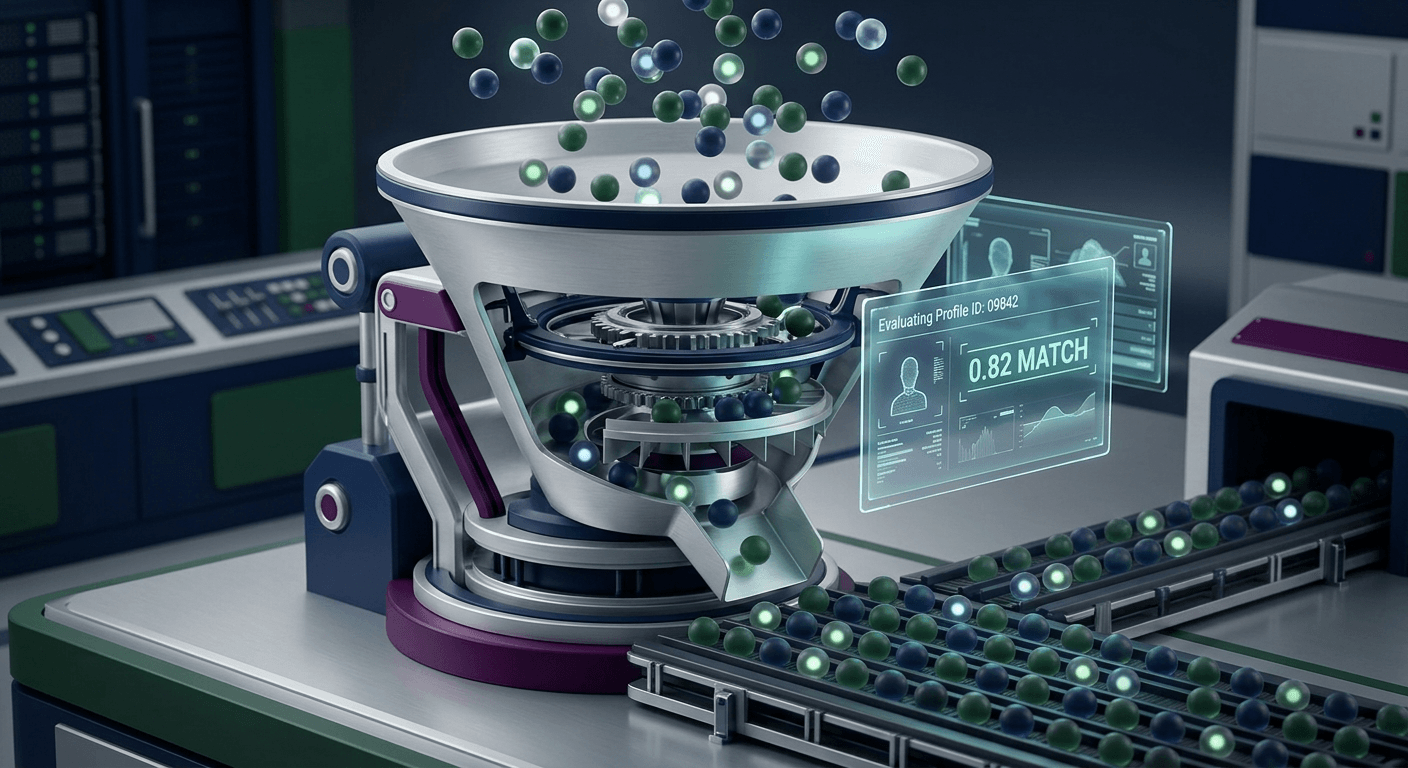
2. Sifting as evidence-matching, not keyword-triage. Where applications exist, the screening layer matches on capability semantics rather than keyword literals: the job's capability fingerprint (built by the placement-intelligence engine) compared against each candidate's verified graph. The output is not a ranked pile of résumés but a ranked pool of evidence: candidate X scored 0.82 on the fingerprint, with verified proof for the three must-have capabilities, one assessed gap, and portfolio artefacts viewable in one click. The 3,000-to-40 triage becomes a 3,000-to-40 computation — hours of recruiter labour replaced by seconds of matching, with better fidelity than the labour ever achieved.
3. The assessment layer: converting "matching" to "ready." Here is the stage the keyword era never had: between shortlist and interview, AI-administered, role-calibrated assessment — structured evaluations, work-sample challenges, the 20-hour challenge architecture run in assessment mode — that converts a paper match into a demonstrated readiness. The candidate who screened at 0.82 now produces fresh, verified evidence of performing the actual work. By the time a human recruiter sees the candidate, the screening question is answered; what remains is the human judgment — fit, motivation, communication — that machines should not own. The recruiter's scarce hours are spent exclusively at the top of the funnel's narrowed end.
4. The scheduling-and-flow layer: velocity as a feature. The leakiest operational stage gets automation: AI-driven scheduling, parallel panel matching, asynchronous first-round formats, candidate-status communication that never goes dark. Time-to-first-interview compresses from weeks to days — and in a market where ready candidates receive competing offers within weeks, velocity is not convenience; it is the difference between hiring the candidate and reading their name on a competitor's announcement.
5. The feedback loop on both sides. Every stage outcome feeds back: which screened candidates passed interviews (calibrating the sift), which hired candidates performed (calibrating the fingerprint), which candidates declined offers (calibrating the pitch and the compensation model). The employer's hiring engine becomes a learning system — the same flywheel property every essay in this series has exploited, applied to talent acquisition.
What Changes for Each Side
The employer hires faster, cheaper, and better: shortlists that arrive pre-verified, recruiter hours spent on judgment instead of triage, and access to a talent pool that includes the graph-verified graduates of stack-connected institutions — a pool competitors still scanning keywords cannot see.
The candidate — and this is the series' real constituency — stops being a lottery ticket. The verified graph, the challenge portfolio, and the engineered identity assets enter the funnel before the résumé lottery begins; the matching engine ensures their evidence is computed rather than skimmed; and the assessment layer lets them demonstrate rather than assert. The first-generation candidate finally competes on capability encoded legibly — the ATS essay's promise, completed end-to-end.
And the institution running the stack gains the ultimate placement advantage: its graduates' verified graphs are queryable by employer-side engines. Placement ceases to be an event — the placement week, the recruiter visit — and becomes a standing pipeline: employers sourcing continuously from evidence, candidates flowing to readiness, the institution functioning as genuine talent infrastructure.
The Honest Caveats
First, automation at the top of the funnel inherits automation's biases. A sift trained on past hires will reproduce past hiring's exclusions — the discrimination problem at computational speed. The defence is structural: match on verified capability evidence, not on proxies (schools, names, gaps, postal codes); audit the engine's pass-rates across candidate segments; and keep the training target on job performance, not on who was historically chosen.
Second, "ready to hire" must mean demonstrated readiness, not profile similarity. The assessment layer is what keeps the machine honest — and the assessment itself must be validated against actual job performance, or the funnel becomes a very efficient pipeline to confident performers rather than capable ones.
Third, candidates are people, and the funnel must not become a dark one. Status communication, consent for graph access, clarity about how they're being evaluated, and human recourse for rejected candidates are not compliance garnish — they are what keeps an automated funnel legitimate for the humans flowing through it.
The Bottom Line
The middle of the hiring funnel — sourcing, sifting, verification, velocity — has been the place where India's talent went to disappear: capable candidates unreached, unreviewed, unscheduled, unhired, at a scale that made matching failure look like a skills shortage.
The mechanics now exist to run that middle properly: sourcing that searches evidence instead of advertising for applications, sifting that computes against verified capability graphs, assessment that converts paper matches into demonstrated readiness, and flow-automation that moves candidates to decision before competitors move to offer.
"Ready to hire" was always a state the candidate had to earn.
The machinery's job is to make sure that when they've earned it —
the funnel can finally see it, prove it, and deliver them — at the speed the market actually hires.


© VidyaShift 2026
Where Learning Becomes Opportunity.
An AI-native learning-to-employment company.