The Faculty Catch-Up: Upskilling All Educators for an AI-Ready Future
Excerpt: The AI transformation of education has a human bottleneck, and it isn't the technology — it's the lakhs of educators expected to run it. Faculty upskilling isn't training programme; it's the profession's reinvention, at pace, at scale, or not at all.
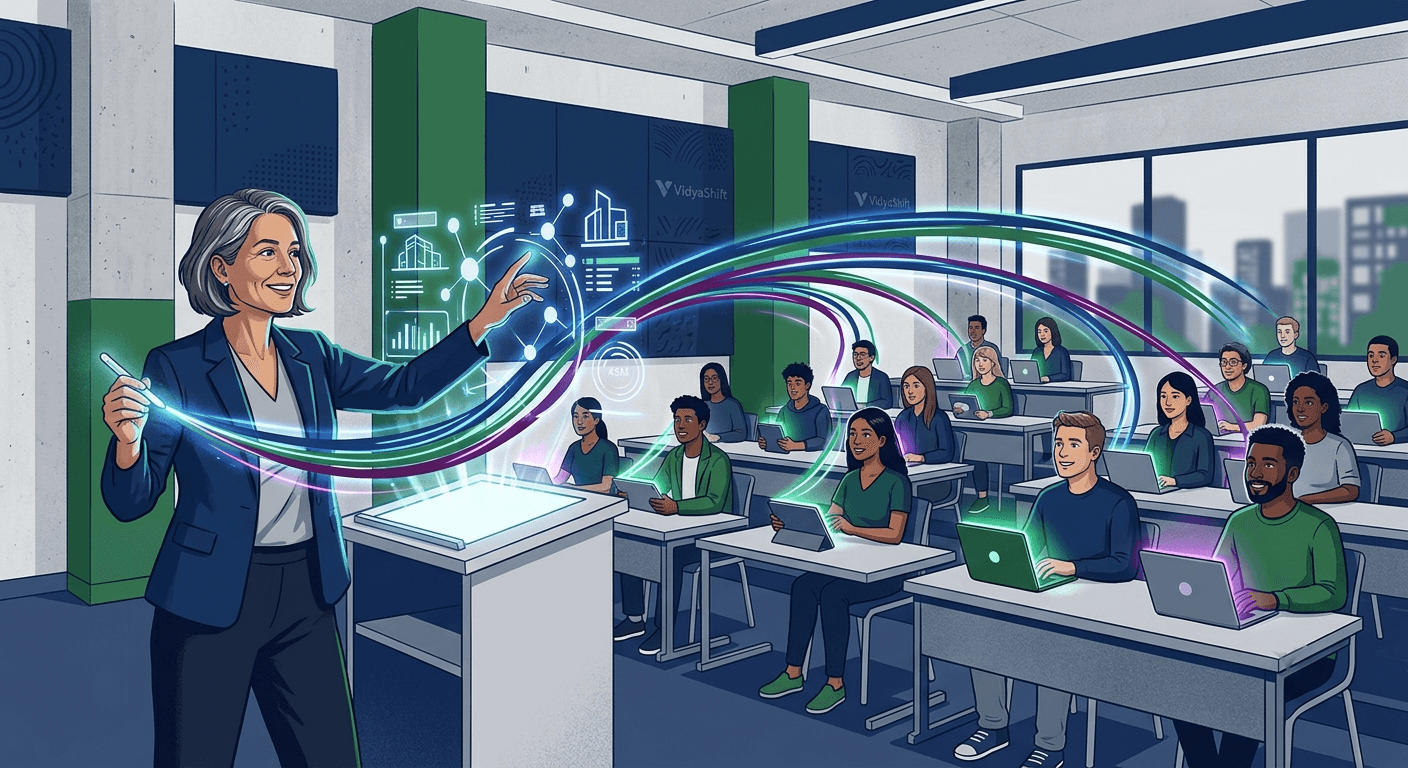
Here is the scene playing out across Indian campuses right now:
A professor with twenty-five years of command over their subject watches a student submit an assignment whose fluency exceeds anything the student has shown in class. Another discovers their lecture's core explanation has been outperformed by a free chatbot — and that their students have known for a semester. A young lecturer is told the college is "adopting an AI platform" and receives, as preparation, a single email with a login. A senior teacher quietly decides the whole thing is a fad and waits, as they have through three previous technology cycles, for it to pass.
This one will not pass.
Every previous essay in this series — faculty leverage, curriculum speed, daily micro-support, continuous QA — has quietly assumed an educator who can work alongside the intelligence layer: directing AI tutors, interpreting dashboards, designing modules, auditing machine judgments, delivering the human moments the machine cannot. The entire architecture has a human dependency, and that dependency is currently unmet at scale. India has lakhs of educators in higher education alone; the median one has received no meaningful AI training, holds rational anxieties about their own displacement, and works in an institution whose incentives have never once rewarded the adaptation now being demanded.
The faculty catch-up is the transformation's most neglected prerequisite — and its most decisive. Every AI ambition in this series is gated not by models or capital, but by whether the person at the front of the room can use what's behind them.
Why Faculty Adaptation Is the Binding Constraint
Three factors make this the choke point rather than one workstream among many:
The architecture routes judgment through humans. The AI layer does the repetition, but every essay here left the professor the judgment: setting the tutor's pedagogy, auditing its grading at the edge cases, reading the risk dashboard, translating market signals into durable curriculum. An educator who cannot perform these oversight functions doesn't get to skip the AI layer — they get a system running ungoverned in their classroom. Faculty incapacity doesn't slow the transformation; it makes it dangerous.
The displacement narrative is running ahead of the augmentation reality. The profession's most common state is neither enthusiasm nor resistance — it is defensive confusion, and it produces the worst of all behaviours: hidden use (AI used secretly, no skill built, no institutional learning), performative bans (driving student use underground and unsupervised), and quiet sabotage of pilots. Every month the profession's legitimate questions go unanswered — will I be replaced? what is my worth now? — the institutional trust the transformation needs is spent.
And time is asymmetric. Student adoption of AI is viral — weeks. Faculty adaptation is institutional — years, unless engineered deliberately. The gap between the two is where the quality incidents live: students miles ahead of their teachers, assessments incoherent, the credibility of the whole educational enterprise eroding one awkward classroom at a time.
What Educators Actually Need to Learn
The catch-up fails when it is designed as "AI awareness training" — a workshop on tools. What the role requires is competence on three levels:
Literacy: what the machine is and isn't. Not to build models — to judge them. How generative AI produces fluent confidences and why hallucination is intrinsic, not incidental; where it excels (explanation, practice generation, drafting, translation) and where it fails (novel reasoning, current facts, genuine assessment); how bias enters and how outputs drift. An educator with honest literacy neither fears the magic nor trusts it — the exact calibration the oversight role demands.
Operation: the workflow skills of the augmented role. Prompting as a professional discipline (directing the tutor's tone, level, and pedagogy); AI-assisted content creation with verification loops; reading and acting on the dashboards; orchestrating the hybrid classroom — the machine carries delivery while the human runs seminars, projects, and mentoring; redesigning assessment for an era when take-home essays are no longer evidence of anything. These are trainable craft skills, and like all craft skills they are learned by doing under feedback, not by watching demonstrations.
Leadership: the pedagogical judgment above the machine. The highest level — and the one no workshop can shortcut: when not to use AI (the struggle that builds capability versus the struggle that just wastes time); how to detect and design around cognitive offloading, the genuine threat that learners who outsource thinking never develop it; the academic-integrity judgments of a world where authorship is ambiguous; and the ethical modelling this series has demanded — using AI honestly, visibly, and with standards, so students learn the discipline by watching it.
The deep design principle, learned painfully by every large-scale teacher-training effort of the past decade: training must be built on the educator's actual work, not on the technology. The unit of upskilling is not "learn prompt engineering" but "redesign next Tuesday's tutorial around the AI tutor, with coaching, with feedback, with your own students." Role-embedded, cohort-based, practised — the same learning science this series applied to students applies, unchanged, to their teachers.
The Institutional Machinery of Catch-Up
Individual educators cannot outrun institutional incentives, so the catch-up is a system redesign with five working parts:
Differentiated pathways, not one programme. The 25-year veteran, the mid-career lecturer, and the new hire need different things — and the digital natives among faculty are an undervalued asset: the reverse-mentoring corridor (young faculty supporting seniors on the operational layer, seniors investing juniors in pedagogy and judgment) is often the fastest trust-builder an institution owns.
Champions and proof before policy. Every institution has a handful of educators already doing remarkable things with AI. Find them, fund them, free them, and make them demonstrate to peers — local proof from local people converts sceptics that no external consultant can reach. Mandates before proof produce compliance theatre; proof before mandates produces pull.
Incentives realigned to the new work. The curriculum-speed essay showed faculty are paid to research, not to stay current; the catch-up inherits the same defect. Career advancement, workload recognition, and appraisal must explicitly credit the augmented-role work — module design, dashboard-informed mentoring, AI-material quality — or the training becomes one more certificate filed and forgotten.
Time, bought by the machine itself. The leverage essay's dividend must be spent on upskilling: the hours AI absorbs from grading and repetition are precisely the hours that fund the adaptation. Institutions that adopt AI and immediately harvest the savings into cost cuts are consuming the very resource the catch-up required — the most common and most fatal budgeting error of the transition.
And psychological safety as policy. The message must be explicit, from leadership, everywhere: augmentation, not replacement — the educator's job is changing, not ending. The leverage essay made the economic case; here it is the management case: professionals who believe they are being automated away will not honestly engage with the systems meant to augment them. Fear produces hidden incompetence; safety produces honest learning. The institutions pairing AI rollout with a credible no-displacement pledge are, in practice, out-training the ones cutting deepest.
The Honest Caveats
First, the timeline tension is real and won't be talked away. AI capability compounds in months; institutional faculty development runs in years. The honest strategy is asymmetric: deploy AI first where educator oversight is least needed (practice, routine feedback, foundational content), buy time, and expand into judgment-heavy territory only as the faculty layer matures — not the reverse.
Second, upskilling ≠ Deprofessionalisation — but the line must be defended. The failure mode of "training faculty for AI" is reducing them to prompt operators and dashboard watchers — deskilled attendants of the machine. The entire argument of this series is the opposite: the machine takes the repeatable work precisely to concentrate the human work. The training must be audited against that promise: does it grow judgment, or merely tool obedience?
Third, some adaptation is genuinely grief, and deserves acknowledgement. An identity built on being the knowledge authority in the room is being renegotiated in real time. Institutions that treat this as a morale problem to be messaged away, rather than a professional transition to be led, will find the resistance is not ignorance — it is mourning. Leadership here is human before it is technical.
The Bottom Line
Every vision in this series — the augmented professor, the two-speed curriculum, the daily micro-support, the national GER machine — ends at the same dependency: an educator capable of working the new layer with judgment, confidence, and authority. That educator does yet exist at scale, and no amount of software will substitute for the shortfall.
The catch-up is not a training calendar. It is the reinvention of a profession — literate in the machine, operational in the workflows, senior in the judgment, incentivised for the new work, and assured that the destination is augmentation rather than erasure.
The technology moved in months. Students moved in weeks.
The profession is moving now — and the institutions that move it deliberately will own the decade that follows.


© VidyaShift 2026

Where Learning Becomes Opportunity.
An AI-native learning-to-employment company.