Near-Zero Marginal: Lifting the Learning Ceiling While Removing the Cost Escalator
Excerpt: Every quality improvement in education has historically cost more. AI breaks the link — better learning now arrives cheaper, not dearer. Here's why that changes everything.
There is one trade-off that has governed every education reform in human history, and almost nobody names it out loud:
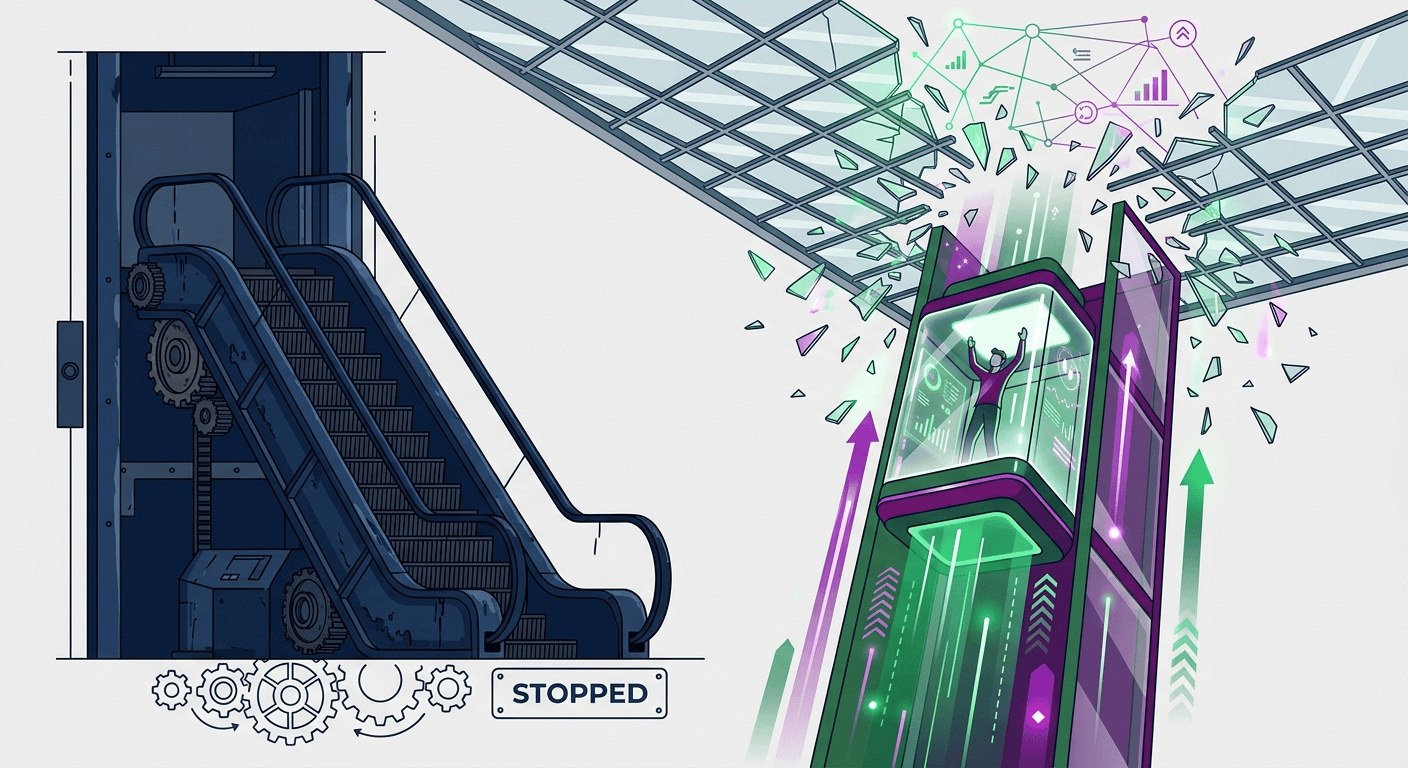
To teach better, you must spend more. And once you spend more, you can never spend less again.
Smaller classes mean more teachers. Better teachers mean higher salaries. Personal attention means lower ratios. Tutoring means one human per child. Every quality gain in education has been purchased with labour — and labour, only gets more expensive. Education quality and education cost have been handcuffed together since the first gurukul, so quality was always rationed by budget, and budgets always lagged need.
Artificial intelligence does something no reform has ever done: it cuts the handcuffs. It lifts the ceiling on how well we can teach while simultaneously removing the escalator that made teaching costlier every year. Understanding how one technology does both — ceiling and escalator — is the key to understanding why this moment in education is genuinely different.
First, the Cost Escalator: Why Education Never Got Cheaper
Every industry that escaped its costs did so through the same mechanism: the marginal cost of the next unit collapsed.
The first car cost a fortune; the millionth cost pennies — engineering, standardisation, the assembly line. The first copy of software costs millions to build; the next copy costs nothing Even electricity, once a luxury of the rich, became almost worthless per unit. Falling marginal cost is what turns an elite privilege into a mass good.
Education resisted this pattern completely. Why? Because the core product is human time. The marginal cost of teaching one more student, in the traditional model, is a teacher's salary — and thanks to Baumol's disease, that salary rises with the whole economy. A university can build more classrooms (cheap, one-time), but it cannot fill them without more teachers (expensive, forever). There was no assembly line for the Socratic dialogue.
So the escalator ran in one direction only. In India: private college fees up multiples of household income growth over two decades. Globally: tuition outrunning inflation in almost every developed economy. Not primarily greed — arithmetic. The one input education couldn't do without was the one input whose price only climbed.
Then, the Learning Ceiling: Why Quality Was Capped
Now look at the other constraint — the ceiling.
We've known since Benjamin Bloom's 1984 research that one-to-one mastery tutoring makes the average student outperform 98% of conventional classrooms. We've known for decades what great education looks like: diagnosis of individual gaps, adaptive re-explanation, mastery before progress, infinite patience.
The ceiling wasn't knowledge. It was replication. Every unit of that quality required a skilled human devoted to one student at a time. Quality, like cost, scaled with labour. So the best education ever described was also permanently unaffordable — available to the rich (through tutors), the lucky (through exam-coaching selection), or.
And here is the trap in one sentence: the only way to make quality affordable was to dilute it into batches — and the only way to keep quality was to price it at a tutor's hourly rate. Ceiling high, escalator fast, and every child standing underneath, hoping.
The Double Break: One Technology, Two Constraints
AI in education is best understood not as a feature but as a collapse of marginal cost in the core product itself.
The core product of education was never the textbook, the building, or the lecture video — those have been cheap and abundant for years. The core product is the responsive tutoring interaction: notice the error, find the root cause, re-explain differently, check mastery, repeat. That interaction consumed a human's time and was therefore subject to both constraints — the escalator (its cost rose forever) and the ceiling (it could never be replicated beyond one student per human).
An AI tutor performs that same interaction in software. The millionth student's conversation costs essentially the same as the first: fractions of a rupee. Watch what this does to both constraints at once:
The escalator stops. For the first time, education's dominant quality-bearing has a near-zero and falling marginal cost. While teacher salaries keep rising with the economy, the AI layer gets cheaper, more capable, and more multilingual with each model generation. Education acquires a component with software economics the first in its history. The per-student cost curve, after centuries of relentless ascent, gains a powerful downward pull.
The ceiling lifts. The interaction that defined the best education on Earth — Bloom's 2 sigma method — is no longer rationed. A student in a government school in Bihar can ask the same question six times at 10 PM, in Maithili, without embarrassment, and receive mastery-gated, root-cause tutoring that a ₹800/hour Delhi tutor sells. Quality stops scaling with human headcount and starts scaling with compute.
The historical parallel is electrification. Before electricity, every factory's power was rationed — one water wheel, one steam engine, carefully allocated. When power became abundant and cheap, factories redesigned themselves entirely. Education's rationed resource — expert human attention — just became abundant. Everything built on the old scarcity now gets redesigned.
What This Unlocks in India Specifically
India stands to gain more than any nation because it sits at the extreme of both constraints simultaneously: the world's largest learning-quality deficit and the world's most cost-sensitive families.
The ceiling-lift closes the coaching gap. India's families pay ₹60,000+ crore annually to a shadow industry whose core product is personal attention rationed by wealth. When doubt-clearing, adaptive practice, and personalised feedback cost near nothing, the Kota family's ₹3 lakh advantage over the Chhapra family's ₹3,000 budget shrinks dramatically. Quality decouples from parental income for the first time.
The escalator-stop rescues public education's budget math. The state cannot hire its way out of the learning crisis — teacher vacancies, training costs, and salary burdens make that arithmetic impossible. But it can put an AI layer across 250 million children at a per-child cost that's a rounding error against teacher salaries, then concentrate human teachers on motivation, mentoring, and the children the system flags as struggling.
Institutions get a new cost floor. As the previous essays in this series argued, distressed colleges and legacy institutions can now restructure so that instruction quality rises while per-student cost falls — previously a contradiction in terms. The affordable college and the good college can, finally, be the same college.
The Honest Caveats
First, near-zero marginal cost doesn't mean near-zero total cost. Devices, connectivity, electricity, and the human mentor layer all still cost money. The windfall arrives in the variable cost of quality instruction — the rest of the system still needs funding and honest management.
Second, the savings can be captured instead of passed on. Institutions can charge tutor prices for an AI wrapper. Without outcome transparency and competition, the escalator stops for producers while prices keep rising for consumers. Technology creates abundance; policy decides its distribution.
Third, the fixed costs are real and concentrated. Building trustworthy, curriculum-aligned, hallucination-guarded AI tutoring requires serious investment and oversight. Near-zero marginal cost with high fixed cost naturally concentrates — raising genuine questions about who owns the tutoring layer for a billion learners, and whether it should be three global companies.
The Bottom Line
For all of recorded history, education faced the same brutal equation: quality scaled with expensive human labour, so quality was scarce and getting dearer. The ceiling said how good we could afford to teach; the escalator said how much more it would cost next year. Both pointed the wrong way.
AI moves both — simultaneously, and in the right directions. The best-known teaching method becomes the cheapest to deliver. The cost curve that rose for centuries bends down. The ceiling that capped every generation's ambition lifts with every model generation.
The countries and institutions that grasp this double break first will not merely reform education. They will enjoy the same advantage Britain had with coal, America with the assembly line: a fundamental input that everyone else still treats as scarce, made abundant at home.
Education was the last great industry still priced like a handmade good.
It just became software.


© VidyaShift 2026
Where Learning Becomes Opportunity.
An AI-native learning-to-employment company.