Designing Short Learning Loops: Why 20-Hour Challenges Accelerate New-Skill Acquisition
Excerpt: Education treats learning as a semester-long commitment, so learners never start. The 20-hour challenge treats learning as a sprint with a finish line — and finishes what semesters never could.
Ask any working professional in India what skill they've been "meaning to learn," and watch the same ritual unfold.
Python. "I've been meaning to learn it for two years." Data analysis. "I enrolled in a course, did two modules." A regional language, financial modelling, design tools, prompt engineering — each one parked in the great national garage of good intentions, where ambitions go to wait for a free weekend that never arrives.
The failure isn't laziness. Diagnose it properly and you find a structural mismatch: education packages learning in units designed for institutions, not for human psychology. A semester is 400+ hours. A MOOC is 40. Even a weekend workshop assumes a full identity change — become a programmer, become an analyst. The working professional, the school student, the mid-career switcher looks at the unit on offer and correctly calculates: I don't have that life available right now. So nothing starts.
Meanwhile, the labour market has never moved faster. The economy needs people to acquire new skills continuously, in weeks, while working. The education system offers sprints of years.
There is a unit of learning that fits both human psychology and market velocity: the short learning loop — most powerfully shaped as the 20-hour challenge. Twenty focused hours is enough to reach genuine functional competence in a bounded new skill: not mastery, but the threshold where the skill becomes usable, valuable, and self-sustaining. This essay is about why that threshold is real, why it accelerates acquisition rather than diluting it, and how to engineer challenges that actually deliver it.
The Science of the Threshold: Why 20 Hours Works
The number isn't arbitrary — it sits on two well-mapped learning curves.
The power law of practice. Skill acquisition follows a brutally steep early curve: the first hours of deliberate practice deliver enormous gains, and returns diminish as competence deepens. Going from zero to functional is the cheapest portion of any learning journey — the beginner learns in one hour what the expert needed ten to refine. Josh Kaufman's popularised research on rapid skill acquisition converged on roughly twenty hours of focused, structured practice as the span needed to move from "frustratingly incompetent" to "reasonably capable" in most bounded skills. Twenty hours won't make you a chef; it will reliably make you someone who cooks real meals without a recipe.
The psychological wall sits at the beginning, not the middle. Learning research and every practitioner's lived experience agree: most abandonment happens in the earliest phase — the window where effort is high, competence is zero, and the learner feels stupid. This is the motivation valley, and it's where semesters and MOOCs lose their learners: they force people to camp in the valley for weeks before any payoff. A well-designed 20-hour challenge is engineered to cross the valley fast — front-loading early wins, deferring theory, and getting the learner to a visible result before motivation dies.
Functional competence is a real economic threshold. The second hour of skill is worth little; the twentieth is worth a lot. An employer doesn't need a 10,000-hour expert for most emerging tools — they need someone at hour 20: can use it, can be trusted with small real tasks, can self-improve from here. For the fast-moving skills of the AI era, hour 20 this quarter beats hour 5,000 in a subject that may be obsolete in three years. In a market that re-prices skills every eighteen months, speed-to-threshold is the scarce capability — and 20-hour loops are the vehicle that delivers it.
The Anatomy of a Challenge That Works
Not every short course is a 20-hour challenge. The difference is design discipline. A real challenge has five non-negotiables:
1. One bounded, demonstrable outcome. Not "learn Python" — an unbounded goal that could consume a lifetime. Instead: build a working data dashboard from a raw CSV in twenty hours. Publish a functional website. Automate real weekly task at your job. The outcome is a thing that exists and works — which converts the goal from a knowledge state (unverifiable, unmotivating) into an artefact (verifiable, motivating, and — per this series' capability graph — portfolio evidence).
2. Deconstruction before instruction. Rapid-skill-acquisition research is emphatic: break the skill into its smallest sub-skills and identify which 20% deliver 80% of the practical value — then start there. The challenge begins with ruthless pruning: what gets learned is what the demonstrated outcome requires, and nothing else. Theory arrives just in time, attached to a problem the learner is currently stuck on — never just in case, front-loaded into a syllabus.
3. Deliberate practice with instant feedback. Twenty passive hours produce nothing; twenty feedback-corrected hours produce competence. Every practice cycle must close fast: attempt → error → correction → retry within minutes, not weeks. This is precisely what the AI layer of this series makes affordable at scale — a tutor that watches every attempt, diagnoses the specific error, and corrects it immediately is the difference between twenty hours of compounding and twenty hours of entrenching mistakes.
4. Barriers engineered down to zero. Every minute spent installing software, finding materials, or deciding what to do next is a minute of the twenty wasted — and a cue to quit. A well-built challenge is a prepared environment: tooling pre-configured, materials sequenced, the next step always obvious. The learner's only job is practice. (Friction that feels trivial to an expert — environment setup, dependency hell — is where beginners die in droves.)
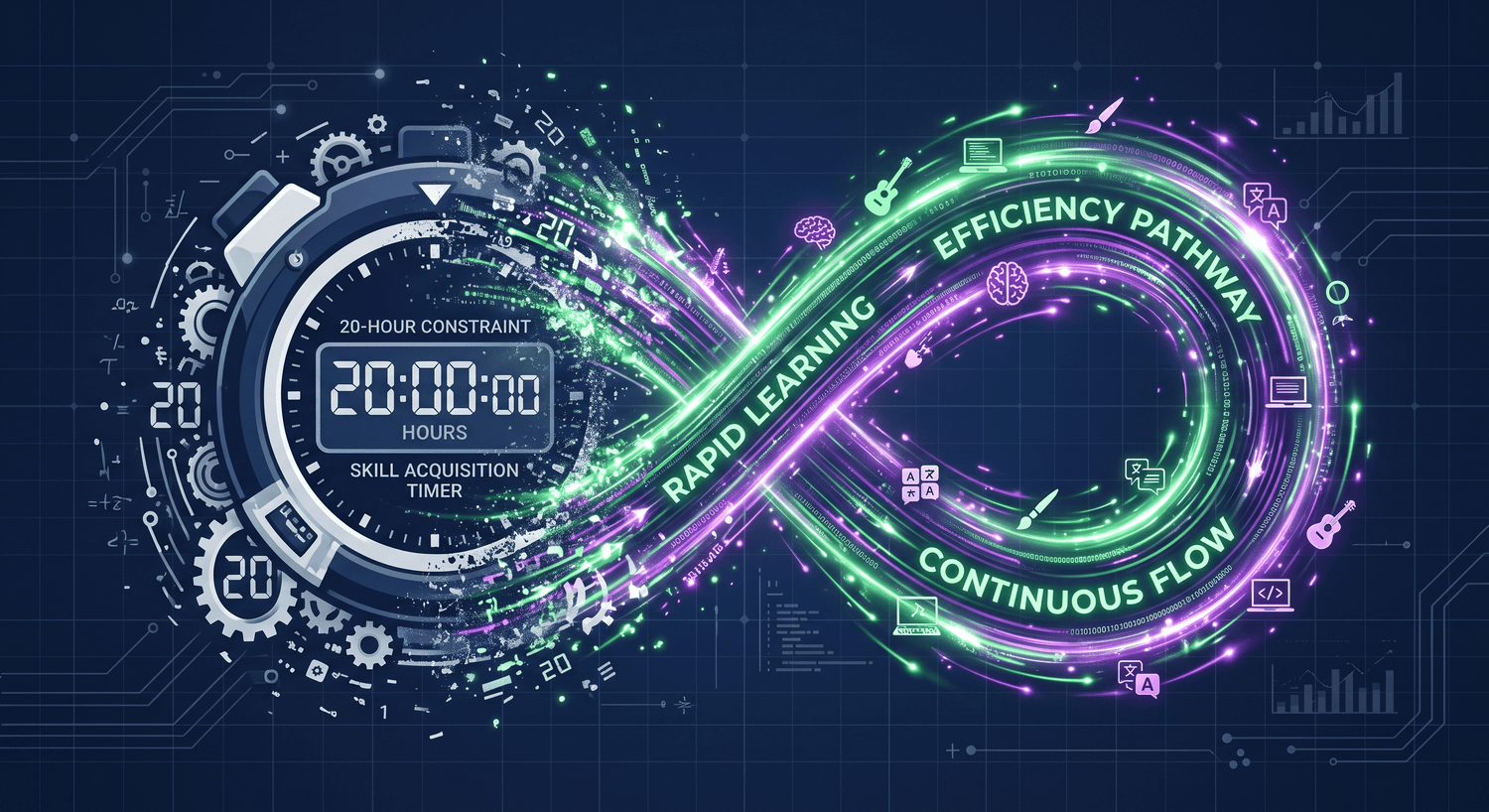
5. A visible clock and a public finish. Twenty hours is short enough to see the end from the start — the motivation design that semesters can never offer. The best challenges add rhythm (an hour a day for a month, a weekend sprint, a team challenge) and a demo moment: show the artefact, defend it, ship it. The finish line is what converts intention into identity: "I built something" becomes "I'm someone who builds things" — the identity shift that makes the next challenge easier to start.
Why Loops Beat Lines
The deeper design insight is the word loop. A 20-hour challenge isn't a compressed course — a shorter line. It's a unit in a cycle:
Challenge → working artefact → verified capability → next challenge at a higher level.
The professional who ships the dashboard challenge now holds a real artefact, a verified capability on their graph, and — crucially — the felt experience of learning something fast. The second challenge takes less overhead than the first. By the third, continuous skill acquisition has become a personal operating system rather than an event. This is the only learning architecture that matches a market where the half-life of skills keeps shrinking: no longer courses, but faster loops, run for a lifetime.
For institutions, loops restructure the product itself. The modular content engine serves challenges natively — each is exactly one versioned module with one assessed artefact. The capability graph gives each challenge a verified outcome that ports to employers. The placement intelligence learns which challenge sequences lead to which roles. And the institution gains something semesters never offered: a continuing relationship with working professionals — the alumni returning every quarter for the next 20-hour loop, LTV compounding the way the intelligence-cycle essay described.
The Honest Caveats
First, twenty hours is a threshold, not a destiny. The challenge produces functional competence — and honesty about that boundary is what keeps it credible. Some skills (medicine, structural engineering, deep mathematics) have no 20-hour version, and pretending otherwise is dangerous. The challenge's honest pitch is narrower and stronger: it gets you to usable, fast, and tells you whether the skill deserves your next thousand hours. It's a trial, a threshold, and a filter — not a substitute for depth where depth is required.
Second, without feedback, it's a hobby, not an acquisition system. Self-directed twenty hours with YouTube videos entrenches errors and stalls at the plateau. The AI tutoring layer isn't decoration here — instant, personalised correction is the mechanism that makes short loops work at all. Institutions stripping the feedback layer to sell cheap content will produce twenty-hour graveyard.
Third, challenge culture can become collection culture. A learner accumulating fifteen artefacts at hour 20 each is a tourist, not a professional. Employers and assessors must read the sequence — what got deepened across loops, what was carried into real work — not just count badges. The capability graph's trajectory view, per the earlier essay, is the antidote: evidence of climbing, not evidence of visiting.
The Bottom Line
Education's unit of learning — the semester — was designed for institutions with buildings and calendars, not for humans with jobs, doubts, and eighteen-month skill cycles. It optimises for coverage and fails at starting: the vast majority of intended learning never begins, because the entry ticket is a life change nobody can afford.
The 20-hour challenge inverts the design: one bounded outcome, ruthlessly deconstructed, practised with instant AI feedback, barriers removed, and a finish line visible from the first hour. It crosses the motivation valley before motivation dies, reaches the economic threshold where skill becomes valuable, produces portfolio evidence instead of unfinished enrolments — and, looped, builds the only capability that outlasts every specific skill: learning fast, on demand, forever.
The semester asked: are you ready to commit your life to this?
The challenge asks something better: what will you have built in twenty hours?
For a market that re-prices skills every year and learners who abandon by week three, that is not the smaller question.
It's the only one that ever gets answered.


© VidyaShift 2026
Where Learning Becomes Opportunity.
An AI-native learning-to-employment company.